Throughout aviation history, many aircraft have been built and operated in an unpainted natural metal finish. During...

Cart 0 Product Products (empty)
No products
Free shipping! Shipping
£ 0.00 Total
Product successfully added to your shopping cart
Quantity
Total
There are 0 items in your cart. There is 1 item in your cart.
Total products (tax incl.)
Total shipping (tax excl.) Free shipping!
Total (tax incl.)
Search Tips
Tips categories
Latest Tips
-
 How do you achieve a natural metal finish on a plastic model aircraft?Read more
 -
 What is the difference between Peak Classes 44, 45 and 46 locomotives?Read more
British locomotive classes 44, 45 and 46 were an early design of diesel-electric locomotive intended for mainline...
-
 What is a superglue activator?Read more
A superglue activator, also known as a cyanoacrylate (CA) accelerator, is a chemical agent designed to speed up the...
-
 Were steam or diesel locomotives routinely used to push as opposed to pulling their loads?Read more
Both steam and diesel locomotives were occasionally used to push their loads instead of pulling them but this...
-
 What type of locomotive is a 'Jinty' and what were they used for ?Read more
The term 'Jinty' refers to a specific type of steam locomotive that was commonly used in the United Kingdom....

What is a feathered edge and how can I create one whilst painting with an airbrush?
A feather edge is a soft blending of the demarcation line between different colours or tones so one gently fades into the other. This can be difficult to achieve with brush painting but an airbrush lends itself well to this technique. There are a number of ways to achieve feathering with an airbrush. The first option is to apply the feather freehand, this is reasonably simple but does require a steady hand! The two contrasting colours should be painted on first with a 'hard' boundary. To create the feather ideally start with the darker colour, then with the airbrush carefully angled gently blur the demarcation line moving from the darker to lighter area. The key here is to avoid moving too far from the demarcation line and use a carefully reduced flow to slowly build up the desired blurring effect.
The freehand technique may not appeal to all modellers. An alternative could be to use either rolled blue-tac/plasticine or rolled masking tape placed along the demarcation line. By carefully angling the airbrush either of these items could be used to gently blur the contrasting edges of the different colours and create a subtle feather. A similar technique is to use a piece of stiff card or paper. Again, with the airbrush gently angled, place the card or paper at the demarcation line and gently raise it from the surface of the model whilst spraying. With careful practice, this will have the effect of gently blurring the demarcation line.
One advantage of using blue-tac, rolled masking tape or paper to help create the feather is each of these items can be applied in a straight line or can easily be shaped to help feather an irregular pattern. All of the techniques mentioned can be used on a wide variety of modelling subjects. They could be equally effective at creating varying layers of dirt or grime on a locomotive or vehicle, or could likewise be used on feathered camouflage patterns on aircraft or ships.
Posted in: Painting
Click here to receive the tips weekly in your mailbox. You can unsubscribe at any time.
Related products
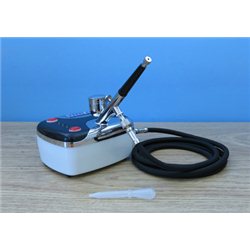
Super Detail Double action airbrush and compressor
Price: £ 99.95AB605 Expo Super Detail Airbrush Deal. Perfect for beginners and experienced...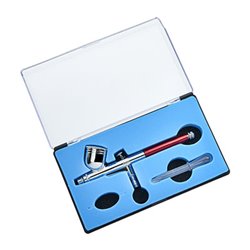
Easy Clean Airbrush with LARGE 7ml Colour Cup
Price: £ 39.95Easy Clean Airbrush with LARGE 7ml Colour Cup Suitable for spraying most type...
Related posts
-
 Do I need to use a primer?For best results it is advisable to use a primer as this will stick to the plastic and give a uniform coat of paint...
 - What is weathering?Weathering is a painting technique used by modellers to create the appearance of dirt and grime and even damage to...
- How do I clean brushes used with enamel paint?Enamel paint is solvent based, so trying to wash in water will not work, you need to use white spirit. It is...
- How do I fill holes in a model?There are many products on the market for filling holes: There are plastic putties straight out of the tube, there...
- What is the best size paintbrush?This would depend on what you are painting as paint brushes come in various shapes and sizes. I would say for...