Historically, the difference between primers and basecoats had much clearer boundaries, a primer sealed and provided...

Cart 0 Product Products (empty)
No products
Free shipping! Shipping
£ 0.00 Total
Product successfully added to your shopping cart
Quantity
Total
There are 0 items in your cart. There is 1 item in your cart.
Total products (tax incl.)
Total shipping (tax excl.) Free shipping!
Total (tax incl.)
Search Tips
Tips categories
Latest Tips
-
 What is the difference between a coloured primer and a basecoat?Read more
 -
 How do I add simple paint chips with a foam sponge ?Read more
When assembly and painting of a model are completed, many modellers will wish to add some degree of wear and tear to...
-
 What tools will I need to build a card-based building kit for my layout ?Read more
There are several tools that will be useful when it comes to building a card-based model kit. These tools will enable...
-
 Why is my DCC locomotive running in the wrong direction?Read more
It's not very often that it happens, but occasionally you may get a DCC locomotive that runs in the opposite...
-
 Can I replace the plastic wheels on my wagons?Read more
A lot of modellers replace the plastic wheels on their wagons with metal ones. But why do they do this? and is it a...

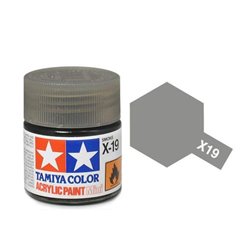
What would I use Tamiya Smoke (X-19) paint for?
Tamiya X-19 Smoke is part of the Tamiya range of acrylic paints. As such it can be brush painted or can be airbrushed onto a wide variety of surfaces such as wood, styrofoam, resin and model plastics such as styrene.
Smoke is intended to mimic the effect of mechanical stains that amass over time, such as exhaust stains and can also be used to mimic other stains such as carbon and cordite build-up from gun barrels. Smoke can also be effective as a post-shading effect on a wide range of colour surfaces including natural metal finishes where it can simulate the presence of accumulated grime and dirt.
Smoke is particularly effective when thinned and applied in a series of light coats that slowly build up the desired staining effect. The ideal thinner is Tamiya Acrylic Thinner X-20A but iso-propyl alcohol (IPA) is equally effective.
Posted in: Painting
Click here to receive the tips weekly in your mailbox. You can unsubscribe at any time.
Related product
Related posts
-
 Do I need to use a primer?For best results it is advisable to use a primer as this will stick to the plastic and give a uniform coat of paint...
 - What is weathering?Weathering is a painting technique used by modellers to create the appearance of dirt and grime and even damage to...
- How do I clean brushes used with enamel paint?Enamel paint is solvent based, so trying to wash in water will not work, you need to use white spirit. It is...
- How do I fill holes in a model?There are many products on the market for filling holes: There are plastic putties straight out of the tube, there...
- What is the best size paintbrush?This would depend on what you are painting as paint brushes come in various shapes and sizes. I would say for...