Building a Metcalfe kit is a great way to gain modelling experience. Building one should not be feared because they...

Cart 0 Product Products (empty)
No products
Free shipping! Shipping
£ 0.00 Total
Product successfully added to your shopping cart
Quantity
Total
There are 0 items in your cart. There is 1 item in your cart.
Total products (tax incl.)
Total shipping (tax excl.) Free shipping!
Total (tax incl.)
Search Tips
Tips categories
Latest Tips
-
 How do I build a Metcalfe kit?Read more
 -
 What is an electromagnetic de-coupler and how would it be used?Read more
An electromagnetic de-coupler is a device used in model railways to separate train carriages without physically...
-
 What to do when plastic cement doesn't cement!Read more
Plastic cement is a formula that temporarily softens and melts the surface of most plastics. This makes it very...
-
 What are open spoke wheels?Read more
Open spoke wheels were a type of early railway wheel that featured double spokes, this type of wheel was commonly...
-
 How can I wash off acrylic paint from unwanted places?Read more
Sometimes, we spend more time trying to remove paint than we do applying it in the first place. Whether it is because...

What is the largest radius OO gauge curve that would fit a 4 ft baseboard?
The average size of a home layout baseboard is 4 ft wide by 6 ft long. If you are planning such a layout, you may well be wondering which radius curves will fit your board.
The good news is, on a 4 ft wide board (that's 1219 mm in new money) you will be able to fit a 4th radius continuous curve onto your layout with 46 mm left to spare (that's 23 mm or just under 1 in. each side of the board). The question is would you want to?
A track located so close to the edge of the board doesn't give any scope for shoulders or scenery so realistic effects will be hard to achieve. You may be better off considering a tighter radius curve and hiding its severity with a tunnel.
A 3rd radius curve will take a lesser 1040 mm to complete a 180-degree turn, leaving approximately 90 mm (3 1⁄2 in) on each side of the board. There's no doubt that's an improvement, but some sort of bone-shaped track plan along the leading edge of the board will probably still be required to create a credible scene.
For those modelling using a flexible track, 18" and 21" Tracksettas are the closest to 3rd and 4th radius curves respectively, although it should be noted these exhibit a slightly tighter radius than their Setrack counterparts.
Whichever method or radius you use is your choice for your railway, but hopefully, you at least now have a better idea of what is and isn't possible.
Posted in: Model Railway
Click here to receive the tips weekly in your mailbox. You can unsubscribe at any time.
Related products
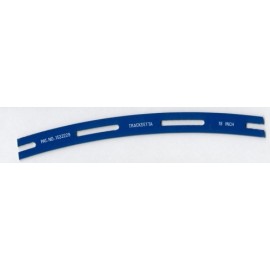
Track Laying Tool 457mm (18in) Radius
Price: £ 9.75Track Laying Tool 18" OO 457mm Radius Use with flexible track. Also suitable...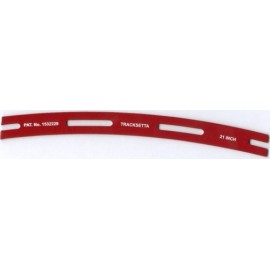
Track Laying Tool 533mm (21in) Radius
Price: £ 9.75Track Laying Tool 21" OO 533mm Radius Use with flexible track. Also suitable...
Related posts
-
 What scale is Hornby?Hornby model railways are OO Scale or 1/76th that is 4 millimetres to the foot (12 inches). It runs on a track with...
 - How to weight my model so it does not tip?For wargaming figures, a small coin or washer glued to the under side of the base will usually to do the job. This...
- Is Bachmann compatible with Hornby?Yes, any OO scale loco, wagon or coach will work on any OO scale track, regardless of brand. Couplings are also...
- What are the model railway eras?According to Bachmann, as it states in their catalogue there are 9 eras. As they say in their catalogue this is not...
- Can a "DCC ready" train be used on analogue?Yes, you can use a DCC ready train on your analogue layout. DCC ready just means that the train has been factory...