A locomotive cradle is a specially shaped sponge block designed to gently but firmly hold a model railway locomotive...

Cart 0 Product Products (empty)
No products
Free shipping! Shipping
£ 0.00 Total
Product successfully added to your shopping cart
Quantity
Total
There are 0 items in your cart. There is 1 item in your cart.
Total products (tax incl.)
Total shipping (tax excl.) Free shipping!
Total (tax incl.)
Search Tips
Tips categories
Latest Tips
-
 Do I need a locomotive cradle?Read more
 -
 What is the best paint to use on a metal locomotive kit?Read more
The best paint to use on a metal locomotive kit depends on your personal preference and the desired finish. Here are...
-
 What is the third rail?Read more
The "third rail" refers to an additional rail that provides electrical power to trains, separate from the two rails...
-
 How do you apply waterslide decals?Read more
Even accomplished modellers will high-five anyone around when their transfers go on seamlessly, they can be a little...
-
 What are lacquer paints?Read more
Lacquer paints refer to a type of paint that is formulated with lacquer as the primary binder or vehicle. Lacquer...

How much ballast do I need for my model railway?
Trying to figure out how much ballast you need to cover your layout is an interesting battle and one you will probably lose!
Some manufacturers do give an approximate track coverage on their bags or tubs of ballast, which is both useful and appreciated, but others err on the side of caution by simply stating how much ballast is contained within their packet, whether that be a cubic measurement or a weight.
The reason for this is that there are so many variables to consider when ballasting track that it would be nearly impossible to come up with a formula to commit a particular bag or tub of ballast to a coverage measurement. Gauge and the size of track shoulders are two of the main factors that determine how far ballast will go as well as individual modeller preferences concerning the depth of their ballast. A track that is raised on a cork bed, for example, will require deeper shoulders while mainlines and sidings may require wider shoulders and so on.
Of course, none of this helps a modeller in a shop trying to decide whether to buy one tub or two for their layout, and shops will never be able to predict an individual's ballasting techniques or design requirements, but maybe you can scale down the problem. Instead of trying to visualise or work out how many tubs or bags will cover an entire layout, consider that a regular coffee mug full of ballast will cover around 3-metres of OO gauge track or 6-metres of N gauge track with a moderate shoulder. Granted, that still doesn't take into account modelling techniques or larger shoulders, but at least you have a chance of visualising how many coffee cups of ballast there are in a bag or tub, which is a lot easier than guessing how many bags or tubs will cover a loft!
Posted in: Tracks
Click here to receive the tips weekly in your mailbox. You can unsubscribe at any time.
Related products
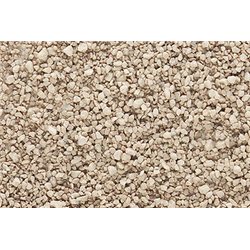
Buff Medium Ballast
Price: £ 16.50Realistically model railroad track, crushed rock and stones. Easy to use and...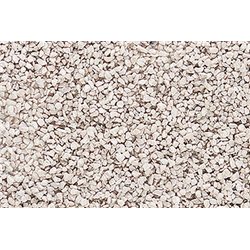
Light Gray Medium Ballast
Price: £ 16.50Realistically model railroad track, crushed rock and stones. Easy to use and...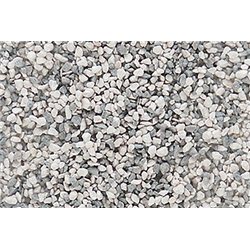
Grey Blend Medium Ballast
Price: £ 16.50Realistically model railroad track, crushed rock and stones. Easy to use and...
Related posts
-
 How to clean model railways track?There is of course the old tried and tested method, the track rubber which does the job, no railway modeller should...
 - Is Peco track and Hornby track compatible?Peco Setrack and Peco Streamline are compatible with Hornby track as they all share the same gauge width of 16.5mm....
- How often should I clean my track?This a hard question to answer. There are no hard and fast rules about how often you should clean the track. Bear in...
- How do I cut flexible track?Once upon a time I would have said a newly bladed junior hacksaw and some warding files, but these days I would have...
- How many pieces of curved track do I need to make a circle?As we all know it takes 360 degrees to create a circle, a standard curve is 22.5 degrees and a double curve is 45...