Sand pipes on a steam locomotive are essential components used to improve traction, especially under slippery...

Cart 0 Product Products (empty)
No products
Free shipping! Shipping
£ 0.00 Total
Product successfully added to your shopping cart
Quantity
Total
There are 0 items in your cart. There is 1 item in your cart.
Total products (tax incl.)
Total shipping (tax excl.) Free shipping!
Total (tax incl.)
Search Tips
Tips categories
Latest Tips
-
 What are the sand pipes on a steam locomotive?Read more
 -
 As a model aircraft enthusiast, what tools should I have?Read more
As a model aircraft enthusiast, having the right tools is essential for a successful and enjoyable building...
-
 Which scale aircrafts are closest to OO gauge?Read more
The closest model aircraft scale to OO Gauge is 1:72 scale. That said, it is still useful to first compare the two...
-
 Is OO easier than N gauge for a beginner?Read more
OO is definitely easier for handling especially for those of us with larger hands and fingers, but otherwise there is...
-
 What is the best way for beginners to power a model railway?Read more
If you have never built a model railway before then it may not be obvious how to supply your model railway tracks...

How do I best use Micro Sol and Micro Set?
Micro Set and Micro Sol decal setting solutions work well in combination in applying decals to uneven surfaces and for providing that painted-on effect.
Prior to applying decals, it is a good idea to ensure that the surface of the model has a gloss finish, this will help in the removal of air bubbles when the decal is applied and will help remove any clouding caused by the decal carrier film. Prior to placing the decal, it is helpful to apply a small amount of Micro Set with a brush to the location required. This will allow the decal to have some movement which will be helpful in precise positioning.
When the decal is correctly placed apply small amounts of Micro Set to the decal with a brush as this will assist with the initial softening of the decal onto the surface. Once the Micro Set has dried then Micro Sol can be applied by brush to the decal to ensure that it correctly contours to any uneven or ridged surface.
Micro Sol is a solvent that softens the backing film and so is best used in small amounts in order not to damage the decal. It is not unusual for the decal to wrinkle at this point, this is part of the curing process. It is important not to touch the decal at this time as it will be very fragile until the Micro Sol has dried and cured.
Additional applications of Micro Sol may be required when applying decals to highly curved surfaces, these should be applied carefully in small amounts and allowed sufficient time to dry. When the desired effect has been achieved it is a good practice to apply a gloss coat over the decal as this will help protect it from scratches and dust and help 'lock in' the decal onto the surface of the model.
Posted in: Decals / Transfers
Click here to receive the tips weekly in your mailbox. You can unsubscribe at any time.
Related products
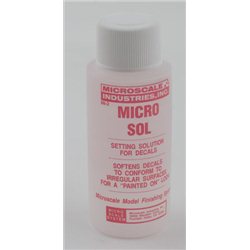
Micro Sol for softening decals
Price: £ 6.00Micro Sol is used for softening decals/transfers so they conform better to...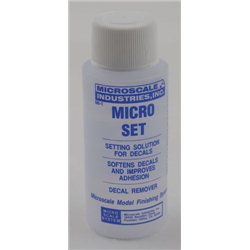
Micro Set for improving the adhesion of decals
Price: £ 6.00Micro Set is used for setting decals/transfers. The solution improves the...
Related posts
-
 Do I need to varnish after applying a decal?The simple answer is yes, it is advisable to varnish your decal, for a couple of reasons One being that if the model...
 - How do I apply decals to irregular surfaces?This is not as difficult as you would think. Normally you would dip your transfer in warm water to help remove it...
- How do I use Micro sol and Micro set with waterslide decals (transfers)?When you are at the final stages of making your model, apply a coat of gloss varnish this will give a nice smooth...
- Do I need to varnish before applying a decal?It is a good idea to give your model a coat of gloss varnish before applying decals as this helps with the gluing...
- Can you just varnish where you intend to place the decals?It is best to varnish the whole model. By coating the whole model in varnish, you are guaranteed a uniform finish...