Removing parts from sprues in a plastic model kit is a crucial step that requires care and precision to avoid...

Cart 0 Product Products (empty)
No products
Free shipping! Shipping
£ 0.00 Total
Product successfully added to your shopping cart
Quantity
Total
There are 0 items in your cart. There is 1 item in your cart.
Total products (tax incl.)
Total shipping (tax excl.) Free shipping!
Total (tax incl.)
Search Tips
Tips categories
Latest Tips
-
 How do I remove parts from the sprues of my plastic kit?Read more
 -
 Is there a quick way to clean model train wheels?Read more
Cleaning the wheels on your rolling stock is an incredibly important job that helps to keep your models running...
-
 What is a Co-Co wheel arrangement?Read more
There are many variations of wheel arrangements for diesel and electric locomotives just as there were with steam...
-
 What is a single action airbrush?Read more
A single-action airbrush is a useful tool in scale modelling, especially if you're looking for a simple yet effective...
-
 What should I set the pressure to on my airbrush?Read more
Most airbrushes will come with a pressure regulator built-in, but what is this facility for, and which pressure...

How much is paint for a model?
If you're lucky enough to know a lot about models and have experience painting them, how much the paint costs, is something you probably don't give much thought to. But equally, there are a lot of people out there either modelling for the first time or buying models and paints as a gift for a loved one, and for them, the world of model paints can be a confusing one with lots of questions.
How much your paint should cost, of course, depends on the amount required and how many different colours are needed to complete the model. For many first time modellers, the temptation will be to buy litres of the stuff as though decorating a lounge, but you will be surprised at how far a small tin of modelling paint goes. For the average kit, a small 15ml tin of paint for each colour required is a good place to start, and these can be picked up for well under £5 each (correct as of 2021). Don't worry if you underestimate the amount of paint needed as all model paints have a code printed somewhere on the bottle or tin so further quantities of that exact colour and shade can always be obtained if necessary.
Where the subject of cost really starts to get interesting, is when you are expecting to do a lot of model painting, as with most products, the greater the volume you buy, the cheaper it becomes, and larger bottles or model-specific paint-sets can nearly half the cost of buying paint. This is great if you are likely to be painting a lot of models sharing the same colour groups, for example, military vehicles, but, for one-off projects or if any future models are likely to require different colours or shades, it's probably best to stick to smaller tins to avoid wastage and keep costs down.
Probably the best way of saving money is to buy paint sets containing several colours suitable for a specific theme. This will also ensure you have the right colours for your project.
Posted in: Painting
Click here to receive the tips weekly in your mailbox. You can unsubscribe at any time.
Related products
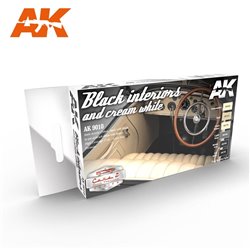
AK Interactive Set - Black Interiors & Cream...
Price: £ 18.99AK Interactive Set - Black Interiors & Cream White SetThis set contains 6 x...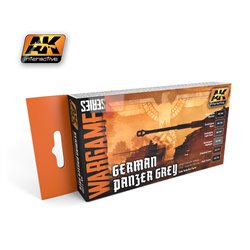
DISC******Mud Set
Price: £ 17.99AK Interactive Set German Panzer Grey Set Contains: AK-1125, AK-1127,...
Related posts
-
 Do I need to use a primer?For best results it is advisable to use a primer as this will stick to the plastic and give a uniform coat of paint...
 - What is weathering?Weathering is a painting technique used by modellers to create the appearance of dirt and grime and even damage to...
- How do I clean brushes used with enamel paint?Enamel paint is solvent based, so trying to wash in water will not work, you need to use white spirit. It is...
- How do I fill holes in a model?There are many products on the market for filling holes: There are plastic putties straight out of the tube, there...
- What is the best size paintbrush?This would depend on what you are painting as paint brushes come in various shapes and sizes. I would say for...