A wide selection of hobby paint ranges can be used very effectively on metal figures.Both enamel and acrylic paints...

Cart 0 Product Products (empty)
No products
Free shipping! Shipping
£ 0.00 Total
Product successfully added to your shopping cart
Quantity
Total
There are 0 items in your cart. There is 1 item in your cart.
Total products (tax incl.)
Total shipping (tax excl.) Free shipping!
Total (tax incl.)
Search Tips
Tips categories
Latest Tips
-
 Which paints are best used to paint OO/HO metal figures?Read more
 -
 How do I glue ballast to my track?Read more
The time old tradition for laying ballast is to lay your ballast under/around your track and add watered down PVA...
-
 How to create your own model mud ?Read more
For many modellers creating scene elements is a significant part of adding extra realism and impact to a layout....
-
 What is a tare weight?Read more
A tare weight is simply a vehicle's unladen weight and is commonly displayed on the side of railway wagons.Tare...
-
 How can I add simple autumnal effects to a layout or diorama?Read more
Some modellers may wish to create specific effects to a layout to help create that specific seasonal effect. There...

Where should I install a siding on my layout ?
A siding is a very useful feature to have on a model railway layout. It provides a designated area for trains to be parked or for additional industries to be served. Installing a siding can add a lot of operational interest to a layout, allowing a modeller to simulate various scenarios such as loading and unloading of freight, or switching operations.
The location of a siding on a layout will depend on a few factors. Here are some considerations to keep in mind :
- Space : the size of the layout will dictate where a siding can be placed. Ideally, there should be enough room to accommodate the length of the train the modeller plans to park on the siding. If space is limited, it may be necessary to consider a shorter siding or even a hidden siding that can be accessed through a tunnel or behind scenery.
- Accessibility : it is important to ensure that the siding is easily accessible for switching operations. It should be possible to reach the siding by hand or with a small tool to couple and uncouple any trains parked there. Placing the siding near the edge of the layout or in an open area can make it easier to reach and operate.
- Track configuration : the layout's track plan will also influence the location of the siding. Siding tracks are typically connected to the mainline track, allowing trains to divert off the mainline and onto the siding. Consideration should be given to the flow of traffic on the layout when choosing a location that makes sense in terms of the track arrangement.
- Operational interest : this can be determined by the purpose of the siding. For loading operations, the siding can be placed in proximity to a goods yard. Alternatively, it can be used to park trains temporarily while other trains pass by on the mainline.
The specific location of the siding will depend on the layout's design and configuration. Experimenting with different options and considering the operational aspects will help a modeller to find the best location for a siding.
Posted in: Model Railway
Click here to receive the tips weekly in your mailbox. You can unsubscribe at any time.
Related products
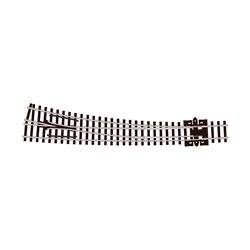
N Curved double radius Right hand Electrofrog
Price: £ 23.70N Curved double radius Right hand Electrofrog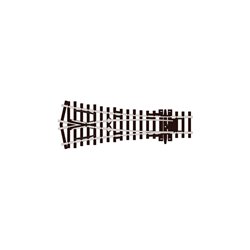
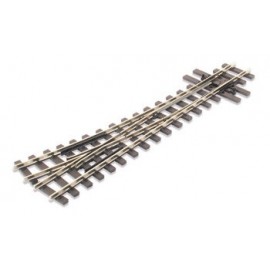
Mainline Right Hand Turnout 18" radius with...
Price: £ 23.40Mainline Right Hand Turnout 18" radius with electrofrog OO9
Related posts
-
 What scale is Hornby?Hornby model railways are OO Scale or 1/76th that is 4 millimetres to the foot (12 inches). It runs on a track with...
 - How to weight my model so it does not tip?For wargaming figures, a small coin or washer glued to the under side of the base will usually to do the job. This...
- Is Bachmann compatible with Hornby?Yes, any OO scale loco, wagon or coach will work on any OO scale track, regardless of brand. Couplings are also...
- What are the model railway eras?According to Bachmann, as it states in their catalogue there are 9 eras. As they say in their catalogue this is not...
- Can a "DCC ready" train be used on analogue?Yes, you can use a DCC ready train on your analogue layout. DCC ready just means that the train has been factory...