A Plux22 DCC decoder is a type of digital decoder used in model railways to control locomotives fitted with a Plux22...

Cart 0 Product Products (empty)
No products
Free shipping! Shipping
£ 0.00 Total
Product successfully added to your shopping cart
Quantity
Total
There are 0 items in your cart. There is 1 item in your cart.
Total products (tax incl.)
Total shipping (tax excl.) Free shipping!
Total (tax incl.)
Search Tips
Tips categories
Latest Tips
-
 What is a Plux22 DCC decoder?Read more
 -
 How to fit drivers in locomotivesRead more
Installing a driver or fireman into your locomotive can really bring it to life and add realism. After all, in real...
-
 What is the best way to glue a cardboard building kit?Read more
The best way to glue a cardboard kit like Metcalfe or Superquick is to read and follow the instructions that are...
-
 How do I replicate faded paint on military scale models?Read more
One of the key challenges you'll face as a military vehicle modeller is capturing that faded, worn appearance that...
-
 When were concrete sleepers first used on British railways?Read more
Concrete sleepers were introduced to British railways as part of an effort to find more durable and longer-lasting...

What is a blanking plate?
A blanking plate is a little circuit board that can be plugged into a DCC model railway locomotive. Its function is to by-pass all of the circuitry that DCC models use therefore turning a DCC model into a regular analogue (DC) model. This alteration is by no means permanent and the decoder can be reinstated at any time. DCC models that are sold brand new with a blanking plate installed are referred to as DCC ready.
DCC models are manufactured to accommodate specific sizes of decoder, some are big and some are small to accommodate different functions or space restrictions within a locomotive's body. To this end, the blanking plates also come in many shapes and sizes, so it's important that if you're planning to purchase a blanking plate to convert your model from DCC to DC that you first check which type and size it is that you require.
Click here to receive the tips weekly in your mailbox. You can unsubscribe at any time.
Related products
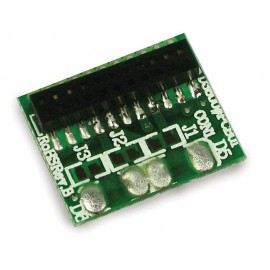
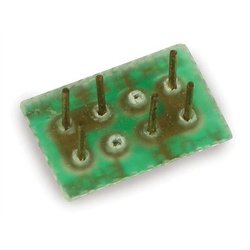
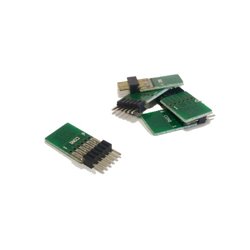
6 Pin Decoder Blanking Plug (Straight) (x5)
Price: £ 6.956 Pin Decoder Blanking Plug (Straight) (x5)
Related posts
-
 What scale is Hornby?Hornby model railways are OO Scale or 1/76th that is 4 millimetres to the foot (12 inches). It runs on a track with...
 - How to weight my model so it does not tip?For wargaming figures, a small coin or washer glued to the under side of the base will usually to do the job. This...
- Is Bachmann compatible with Hornby?Yes, any OO scale loco, wagon or coach will work on any OO scale track, regardless of brand. Couplings are also...
- What are the model railway eras?According to Bachmann, as it states in their catalogue there are 9 eras. As they say in their catalogue this is not...
- Can a "DCC ready" train be used on analogue?Yes, you can use a DCC ready train on your analogue layout. DCC ready just means that the train has been factory...