We often hear modellers refer to their "fiddle yard", but unless you already know what one is, the name doesn't...

Cart 0 Product Products (empty)
No products
Free shipping! Shipping
£ 0.00 Total
Product successfully added to your shopping cart
Quantity
Total
There are 0 items in your cart. There is 1 item in your cart.
Total products (tax incl.)
Total shipping (tax excl.) Free shipping!
Total (tax incl.)
Search Tips
Tips categories
Latest Tips
-
 What is a fiddle yard?Read more
 -
 What is point rodding in model railways?Read more
Point rodding is a system of rods and bars that physically joins the lever of a signal box or ground frame with a set...
-
 What scale is a 28mm figure used by wargamers?Read more
28mm wargaming figures, sometimes referred to as miniatures, are the most popular scale of gaming figures on the...
-
 Why are most diesel locomotives double-ended whereas most steam locomotives were not?Read more
The reason why most diesel locomotives are double-ended, meaning they have a cab and controls at both ends, while...
-
 Is wood better than plastic for modelling?Read more
When it comes to scale modelling, the debate between using wood or plastic is a long-standing one. Both materials...

How can I prevent my layout becoming a dust trap when not in use?
One of the perennial problems of being a modeller is that our models or layouts sometimes become very efficient dust traps or adventure playgrounds for household spiders and other unseen denizens lurking in the shadows. There are many ways to deal with these issues such as craft brushes or air cans that are used to remove dust. Likewise, there are a number of manufacturers who have created a variety of products specifically formulated to remove dust and debris from models and layouts. These products and processes generally serve us well but there is also a downside. As many modellers will attest, damage is most likely to occur when setting up, breaking down or cleaning models.
Bearing in mind this last point, it is not a bad idea to approach this subject with a mindset of 'Prevention is better than cure'. Some models are small and compact enough that they can easily be kept in storage boxes when not in use. Likewise, certain scene elements of a layout such as vulnerable buildings can be configured to be removable so that they can be stored separately when not in use.
Unfortunately, storage boxes may not always be a practical option for a large layout when not in use which means it is then open to time-related colonisation by dust. One option to circumvent this issue may be to create a purpose-made cover for the layout. This can be in the form of a simple but sturdy wooden frame hung with light fabric such as an old bedsheet or curtain material. This can provide a significant amount of protection from accumulated dust and debris. This material covering also has the added benefit of protecting the layout from sun-bleaching.
Posted in: Model Railway
Click here to receive the tips weekly in your mailbox. You can unsubscribe at any time.
Related product
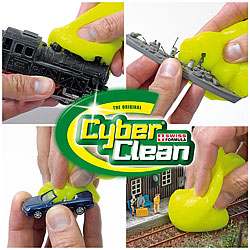
DISC**Cyber Clean
Price: £ 5.99Cyber Clean Model Cleaner - neat and simple to use:Just simply roll over, or...
Related posts
-
 What scale is Hornby?Hornby model railways are OO Scale or 1/76th that is 4 millimetres to the foot (12 inches). It runs on a track with...
 - How to weight my model so it does not tip?For wargaming figures, a small coin or washer glued to the under side of the base will usually to do the job. This...
- Is Bachmann compatible with Hornby?Yes, any OO scale loco, wagon or coach will work on any OO scale track, regardless of brand. Couplings are also...
- What are the model railway eras?According to Bachmann, as it states in their catalogue there are 9 eras. As they say in their catalogue this is not...
- Can a "DCC ready" train be used on analogue?Yes, you can use a DCC ready train on your analogue layout. DCC ready just means that the train has been factory...