One of the most useful tools for a modeller to have in their tools/supplies stash is modelling two-part epoxy putty...

Cart 0 Product Products (empty)
No products
Free shipping! Shipping
£ 0.00 Total
Product successfully added to your shopping cart
Quantity
Total
There are 0 items in your cart. There is 1 item in your cart.
Total products (tax incl.)
Total shipping (tax excl.) Free shipping!
Total (tax incl.)
Search Tips
Tips categories
Latest Tips
-
 How can I use two-part epoxy putty on my model or layout?Read more
 -
 What is polystyrene?Read more
Polystyrene is a versatile plastic material that is widely used for crafting highly detailed miniatures and models....
-
 How tall should trees be in N gauge?Read more
Trees come in all shapes and sizes, some you can stand under and not be able to reach the bottom branch, some bottom...
-
 What is a superglue activator?Read more
A superglue activator, also known as a cyanoacrylate (CA) accelerator, is a chemical agent designed to speed up the...
-
 Which scale aircrafts are closest to OO gauge?Read more
The closest model aircraft scale to OO Gauge is 1:72 scale. That said, it is still useful to first compare the two...

What is a pin pusher?
A pin pusher is a special tool designed to hold a small pin, tack or nail in place while you use the handle to push it into a board or wall. This makes them ideal for installing track pins or nails.
If you have ever laid flexible track, then you will know what a tedious job it can be trying to get the pin in place without bending it in two or scuffing the rails with your hammer as you drive the pin home. A pin pusher saves you all of the blood, sweat, tears and swear words and is the best friend of many modellers.
The device is very simple and looks a bit like a screwdriver without its tip. Instead, there is a hole into which you insert a track pin, then it is simply a case of using the tool to push the pin into your baseboard.
For what they cost, they will save you time, effort and most importantly, your sanity!
Posted in: Assembling and gluing
Click here to receive the tips weekly in your mailbox. You can unsubscribe at any time.
Related products
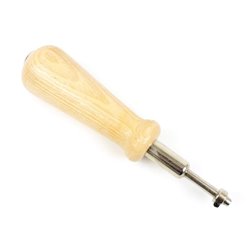
DISC**Pin Pusher with Depth Stop
Price: £ 14.75Pin Pusher with Depth StopFits all known brands of Track Pin!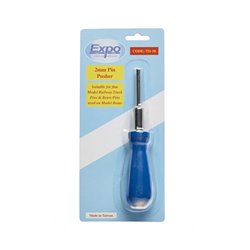
High Quality Pin Pusher 2mm
Price: £ 8.95High Quality Pin Pusher 2mm The Expotools 2 mm Pin Pusher is a useful tool...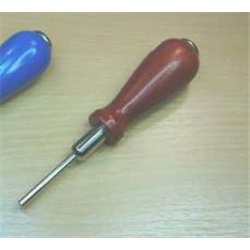
High Quality Pin Pusher 3mm
Price: £ 8.95High Quality Pin Pusher 3mm 3mm - for heavier track pins such as Hornby.
Related posts
-
 Do I need to wash my plastic kit?I personally wash all my plastic kits, I use warm soapy water (Washing up liquid) and a light rub over with a nail...
 - What is Milliput?Milliput is a two-part epoxy putty. There are two different colour rolls in a box when these are mixed together it...
- What modelling tools do I need to get started?Most modellers have an extensive tool kit, a tool for every eventuality. But when first starting a scalpel or a...
- How do I remove parts from the sprue?The short answer is carefully. The best way is with a sprue and plastic cutter but always be mindful of exactly...
- Do I need a cutting mat?It is not essential to have a cutting mat, but it is a good idea. It saves getting in trouble with your significant...