Model trains certainly run at a voltage low enough that they can be operated from batteries, and as lithium batteries...

Cart 0 Product Products (empty)
No products
Free shipping! Shipping
£ 0.00 Total
Product successfully added to your shopping cart
Quantity
Total
There are 0 items in your cart. There is 1 item in your cart.
Total products (tax incl.)
Total shipping (tax excl.) Free shipping!
Total (tax incl.)
Search Tips
Tips categories
Latest Tips
-
 Can you run a model train from batteries?Read more
 -
 What is a track rubber?Read more
A track rubber looks like a standard eraser that you would use to rub out unwanted pencil lines on a piece of paper....
-
 What is a superglue activator?Read more
A superglue activator, also known as a cyanoacrylate (CA) accelerator, is a chemical agent designed to speed up the...
-
 Is ballast grey or brown?Read more
Ballast can be either colour. If you are creating a layout of a prototype line then you should try and stick as...
-
 Where is the best place to store my layout when not in use?Read more
One of the trickiest issues with operating a model train layout is where to store it when not in use. There are a...

How can I create a simple water feature on my layout?
Adding a simple water feature to a layout can be a reasonably straightforward process and can add a real interest factor to a layout. That said, it does take a little bit of planning and preparation. The first consideration will be to identify a suitable horizontal location, especially for standing water such as a pond or a mere. The ideal location will need to be a little deeper than its surroundings, perhaps 3-5mm. It will help if the depth is uneven as this can help add to the interest factor of the completed feature.
Once the location and depth have been determined then it will be useful to get a small amount of suitable substrate materials such as sand, gravel or a mixture of the two. To add a further level of realism, it could be useful to add a few larger rocks and dark green scatter to help hint at pond life. When the contents of the feature are complete then it can be covered with a suitably cut clear plastic sheet to simulate the surface. The banks of the feature can now be built up with a suitable choice of scatter. This could be useful in simulating mud or sand as required, it also has the added benefit of hiding any glue seams used to glue the clear plastic surface in place.
Further added interest could be included by adding water features such as a duck house, fountain or a large semi-submerged rock or stone. It might be possible to cut the clear plastic to fit around them at the planning stage, or with careful application, it may be possible to glue them to the clear surface, perhaps with some surrounding greenery to help blend in the feature.
Not all standing water is transparent. When simulating a fen or mere it can be useful to add a delicate dark green or green-black overspray from an airbrush. Add a delicate coat of clear to hint at reflectivity and then suitable green scatter, such as lily-pads can be added to the surface. Tufty scatter such as coarse grass or reeds can further be added to the margins to hint at a diverse aquatic environment.
Posted in: Scenery
Click here to receive the tips weekly in your mailbox. You can unsubscribe at any time.
Related products
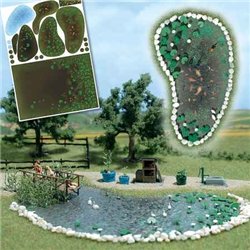
Garden Pond Set
Price: £ 18.50Add realistic garden and landscape ponds to your layout or scene. The special...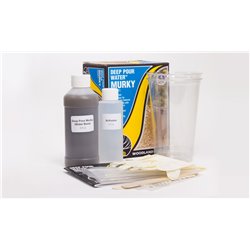
Murky Deep Pour Water
Price: £ 44.75Deep Pour Water – MurkyCreate underwater features with Deep Pour Water and...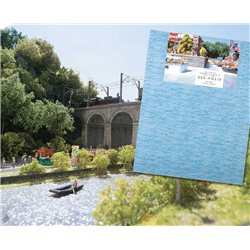
Water Sheet
Price: £ 10.75Natural appearing water with ripples. With coloured paper underlayment. For...
Related posts
-
 Is static grass better than scatter?I use both, separately and together. Static grass comes in various sizes from 0.5mm to 12mm while scatter is...
 - How do I apply static grass?Static grass is best applied using a static grass applicator. There are several on the market and they can apply...
- What colour are tree trunks?Tree trunks are actually grey in colour and not brown as you would think. The next time you are out and about just...
- How to make hills?You can make hills in a variety of ways. The tried and tested way is with chicken wire and papier mache. This is a...
- How do I glue scatter?Select the area where you want the scatter, then apply a layer of PVA glue, sprinkle your grass covering the glue....