Buckeye couplings, also known as Buckeye knuckle couplers, are a type of railway coupling used primarily in North...

Cart 0 Product Products (empty)
No products
Free shipping! Shipping
£ 0.00 Total
Product successfully added to your shopping cart
Quantity
Total
There are 0 items in your cart. There is 1 item in your cart.
Total products (tax incl.)
Total shipping (tax excl.) Free shipping!
Total (tax incl.)
Search Tips
Tips categories
Latest Tips
-
 What are buckeye couplings?Read more
 -
 Where could I position a gantry hoist on my layout ?Read more
A gantry hoist is a useful addition to a model railway layout as it can add realism and functionality. Used to lift...
-
 Why does my railway analogue controller keep cutting out?Read more
There are a few reasons why your analogue controller could be cutting out, but the most probable cause is a short...
-
 What is a glass fibre pencil?Read more
Glass fibre pencils are commonly used in modelling for cleaning locomotive wheels, commutators and other electrical...
-
 What is a 3D printer?Read more
A 3D printer is a machine that literally prints three-dimensional objects. That sounds great! and it would be easy to...

What is a scale ruler?
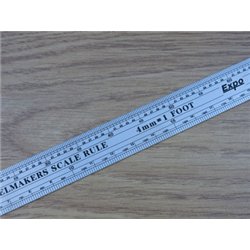
At first glance, a scale ruler appears like any other measuring device, but on closer inspection, you will notice that the measurements printed on the ruler are not what we are used to seeing on a regular ruler.
The purpose of a scale ruler is to figure out how big a real-life measurement would be on a model.
For example, if you wanted to build an engine shed on your layout and the real-life engine shed that you wanted to recreate measured 100ft in length, then all you would need to do is measure 100ft on the scale ruler and that will give you the scaled-down equivalent.
This is particularly useful for modellers that like to scratch-build as it negates the need to constantly convert real-life measurements from the prototype into millimetres. Another useful application of a scale ruler is when you are drawing up the plans at the start of a model railway project. Using a scale ruler you can easily mark out various sections on your baseboard saving you the headache of cramming diorama into an over-ambitious track-plan (trust us, we’ve all been there).
Scale rulers are available in a multitude of different scales, model scale rulers are specific to railway gauges so you can get them for 00 gauge, N gauge, 0 gauge and so on, this makes using the ruler very simple.
Posted in: Kit building
Click here to receive the tips weekly in your mailbox. You can unsubscribe at any time.
Related products
Related posts
-
 Do I need to wash my plastic kit?I personally wash all my plastic kits, I use warm soapy water (Washing up liquid) and a light rub over with a nail...
 - What is Milliput?Milliput is a two-part epoxy putty. There are two different colour rolls in a box when these are mixed together it...
- What modelling tools do I need to get started?Most modellers have an extensive tool kit, a tool for every eventuality. But when first starting a scalpel or a...
- How do I remove parts from the sprue?The short answer is carefully. The best way is with a sprue and plastic cutter but always be mindful of exactly...
- Do I need a cutting mat?It is not essential to have a cutting mat, but it is a good idea. It saves getting in trouble with your significant...