Modelling a heritage railway offers several unique advantages that make it a rewarding project.Nostalgia and...

Cart 0 Product Products (empty)
No products
Free shipping! Shipping
£ 0.00 Total
Product successfully added to your shopping cart
Quantity
Total
There are 0 items in your cart. There is 1 item in your cart.
Total products (tax incl.)
Total shipping (tax excl.) Free shipping!
Total (tax incl.)
Search Tips
Tips categories
Latest Tips
-
 What are the advantages of modelling a heritage railway?Read more
 -
 How did train drivers read semaphore signals at night?Read more
Semaphore signals were a common form of railway signalling before the advent of modern electronic signals. During the...
-
 How do I know if my paint is too old?Read more
If like most modellers, you have an abundance of used model paints lying around, you will be familiar with the pang...
-
 What is a B4 bogie?Read more
Bogies are an independent framework that supports the wheelsets on a railway locomotive, coach or some larger wagons....
-
 Do I need to apply a camber to a tight curve of track on my layout?Read more
Applying a camber to a tight curve of track on your model railway layout can help improve the realism and operation...

What is the difference between Point-to-point and Continuous run?
Point-to-point and Continuous-run are terms used to describe two different options for layout designs. Layout configuration is one of the first decisions that a modeller will make with regard to a new layout. Inevitably this decision may be dependent on a number of factors including the level of realism required and the available space for the layout.
Point-to-point layouts are designed to replicate the look and operation of a real railway line that travels from one point to another. These layouts typically feature a mainline that runs through a series of stations, sidings and other facilities and are operated by moving trains from one end of the layout to the other. The trains will typically stop at each station or siding and may need to be switched or shunted to reach their final destination. Point-to-point layouts are often used to model specific locations or industries and as a result, can be highly detailed and realistic.
Continuous run layouts, on the other hand, are designed for trains to run continuously around a loop or oval track without stopping. These layouts are often more focused on the operation of the trains themselves rather than the scenery or details of the layout. Sometimes economies of space may drive the decision to adopt a continuous-run orientated layout. These layouts may have multiple tracks and loops to allow for more complex train movements in a reduced area. Continuous run layouts are often used for testing or displaying model trains and can be less detailed than point-to-point layouts.
Overall, the main difference between point-to-point and continuous-run layouts is in the way they are designed and operated. Point-to-point layouts are focused on replicating the look and feel of a real railway line, whereas Continuous-run layouts are designed for the continuous operation of trains through a series of closed loops of track.
Posted in: Model Railway
Click here to receive the tips weekly in your mailbox. You can unsubscribe at any time.
Related products
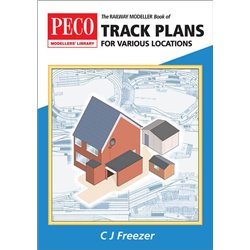
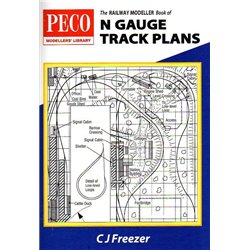
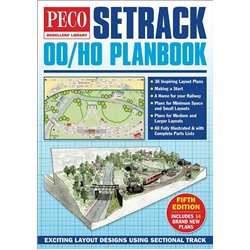
OO/HO Setrack Planbook 5th Edition
Price: £ 3.75This book is the new edition of a PECO bestseller and includes lots of new...
Related posts
-
 What scale is Hornby?Hornby model railways are OO Scale or 1/76th that is 4 millimetres to the foot (12 inches). It runs on a track with...
 - How to weight my model so it does not tip?For wargaming figures, a small coin or washer glued to the under side of the base will usually to do the job. This...
- Is Bachmann compatible with Hornby?Yes, any OO scale loco, wagon or coach will work on any OO scale track, regardless of brand. Couplings are also...
- What are the model railway eras?According to Bachmann, as it states in their catalogue there are 9 eras. As they say in their catalogue this is not...
- Can a "DCC ready" train be used on analogue?Yes, you can use a DCC ready train on your analogue layout. DCC ready just means that the train has been factory...