The S scale denotes a ratio of 1:64. This scale signifies that one unit of measurement on the model corresponds to 64...

Cart 0 Product Products (empty)
No products
Free shipping! Shipping
£ 0.00 Total
Product successfully added to your shopping cart
Quantity
Total
There are 0 items in your cart. There is 1 item in your cart.
Total products (tax incl.)
Total shipping (tax excl.) Free shipping!
Total (tax incl.)
Search Tips
Tips categories
Latest Tips
-
 What is S scale?Read more
 -
 What should I set the pressure to on my airbrush?Read more
Most airbrushes will come with a pressure regulator built-in, but what is this facility for, and which pressure...
-
 How can I add rust and weathering effects to white metal parts?Read more
A number of modellers will work with white metal components as either part of their model or as additional...
-
 What are my options for motorising a level crossing?Read more
There are a few options for motorising a level crossing on a model railway layout: Servo motor: One option is to use...
-
 How do I know if my paint is too old?Read more
If like most modellers, you have an abundance of used model paints lying around, you will be familiar with the pang...

Where is the best place to store my layout when not in use?
One of the trickiest issues with operating a model train layout is where to store it when not in use. There are a number of potential options for storage of a layout but not all may be practical and all have pros and cons. Firstly, some modellers are fortunate in that their layout can be permanently rigged so storage is not a concern. The layout in question is in a location given over to its operation. Inevitably the space in question has been configured for the permanent operation of a layout which will include sufficient space for operation, a continuous electrical supply, adequate lighting and heating.
Inevitably there is a lot of competition for space in most households, this may necessitate that any layout has to be mobile in nature and as such, it may have been built in modules that can be easily joined together and broken down when not in use. Wherever possible it is ideal to store the layout close to the location where it is likely to be operated. In many cases, this location may be a spare bedroom. In this particular instance, an ideal location for storage will be a storage cupboard. The advantages of this are that it should be reasonably close to the intended operating location making movement of modules less problematic. Another big advantage of storage in a cupboard is that it is likely to be dust free, unlike under the bed which is one of the worst places for storage as it tends to be a fluff and debris trap. Another big advantage of an indoor location is that the impact of seasonal temperature and humidity variations is minimised to some degree.
Many modellers may use alternative locations for storage such as loft spaces, the garage or a garden shed. These may allow for greater space availability and subsequent storage which is a significant plus in their favour. The downside to all of these locations is that they may only have a very rudimentary electrical supply. As such they may not be heated and are subject to temperature and humidity variations which can be a cause for concern. Long term however the space they offer may make them a good location and worth the investment of installing power and heating.
Posted in: Model Railway
Click here to receive the tips weekly in your mailbox. You can unsubscribe at any time.
Related product
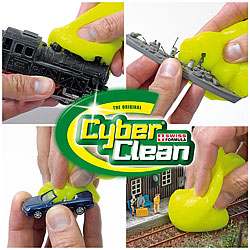
DISC**Cyber Clean
Price: £ 5.99Cyber Clean Model Cleaner - neat and simple to use:Just simply roll over, or...
Related posts
-
 What scale is Hornby?Hornby model railways are OO Scale or 1/76th that is 4 millimetres to the foot (12 inches). It runs on a track with...
 - How to weight my model so it does not tip?For wargaming figures, a small coin or washer glued to the under side of the base will usually to do the job. This...
- Is Bachmann compatible with Hornby?Yes, any OO scale loco, wagon or coach will work on any OO scale track, regardless of brand. Couplings are also...
- What are the model railway eras?According to Bachmann, as it states in their catalogue there are 9 eras. As they say in their catalogue this is not...
- Can a "DCC ready" train be used on analogue?Yes, you can use a DCC ready train on your analogue layout. DCC ready just means that the train has been factory...