Most model railways struggle to accommodate full-sized passenger trains, to do so would require huge platforms and...

Cart 0 Product Products (empty)
No products
Free shipping! Shipping
£ 0.00 Total
Product successfully added to your shopping cart
Quantity
Total
There are 0 items in your cart. There is 1 item in your cart.
Total products (tax incl.)
Total shipping (tax excl.) Free shipping!
Total (tax incl.)
Search Tips
Tips categories
Latest Tips
-
 How long should my passenger train be?Read more
 -
 What is a tank wagon?Read more
A tank wagon or tanker is a type of railway wagon used specifically for transporting liquids or gasses.Tank...
-
 How do you seal paint?Read more
After spending hours preparing and painting your models, it is quite understandable that you would want to protect...
-
 What is a dropper wire?Read more
When using a bus wire (shared common wire) to distribute power around your layout, you will inevitably have to tap...
-
.jpg "Do I need signals on my layout?") Do I need signals on my layout?Read more
Do I need signals on my layout?Read moreThe purpose of signals is to let the driver know if there was another train on the line, pretty much the same as...

How can I easily make a shingle or asphalt roof for a building?
Outbuildings come in a variety of roofing styles and many can be modelled quite easily and cheaply with materials that might be readily at hand. Many modellers scratch-build buildings for a layout or diorama, or wish to add a little more texture to a card-based kit. Inevitably, when first viewed most layouts or dioramas are seen from above and so the roofs of any buildings are one of the most obvious features.
Used sandpaper can be very effective at mimicking asphalt or shingle-tiled roofs. Used sandpaper is robust yet flexible. It can be cut into a sheet to represent an asphalt roof or can be cut into individual tiles to represent roof tiles in O or OO/HO gauge. Likewise, it can be gently folded with tweezers or a ruler to form ridge tiles. It can then be given a light coat of a suitable shade of acrylic or enamel paint so that it mimics not only the texture but also the colour of the roof cover in question.
Posted in: Assembling and gluing
Click here to receive the tips weekly in your mailbox. You can unsubscribe at any time.
Related products
DISC**HO asphalt single card sheet
Price: £ 1.99HO asphalt single card sheet Coloured printed card. Big enough to accommodate...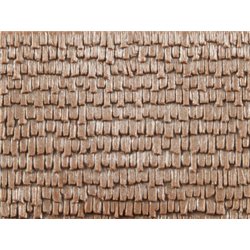
Related posts
-
 Do I need to wash my plastic kit?I personally wash all my plastic kits, I use warm soapy water (Washing up liquid) and a light rub over with a nail...
 - What is Milliput?Milliput is a two-part epoxy putty. There are two different colour rolls in a box when these are mixed together it...
- What modelling tools do I need to get started?Most modellers have an extensive tool kit, a tool for every eventuality. But when first starting a scalpel or a...
- How do I remove parts from the sprue?The short answer is carefully. The best way is with a sprue and plastic cutter but always be mindful of exactly...
- Do I need a cutting mat?It is not essential to have a cutting mat, but it is a good idea. It saves getting in trouble with your significant...