In the context of UK railways, a "four-aspect signal" is a type of railway signal that provides four distinct...

Cart 0 Product Products (empty)
No products
Free shipping! Shipping
£ 0.00 Total
Product successfully added to your shopping cart
Quantity
Total
There are 0 items in your cart. There is 1 item in your cart.
Total products (tax incl.)
Total shipping (tax excl.) Free shipping!
Total (tax incl.)
Search Tips
Tips categories
Latest Tips
-
 What is a 4 aspect signal?Read more
 -
 How to use a track gauge like Peco SL-36 and SL-336?Read more
Track gauges of this type don't look like much when you take them out of the box and it's often hard to see how to...
-
 What are 'lowmac' wagons and how were they used?Read more
The term "lowmac" refers to a type of flat wagon used for transporting heavy goods or machinery. The name "lowmac" is...
-
 What is a 'Beetle' van?Read more
A 'Beetle Van' is a term used to describe a wagon specifically designed to carry prize cattle or other valuable...
-
 How much paint is required for a model kit?Read more
Once you have chosen a model to keep you occupied for a weekend or two, you will need to buy some paint to finish it...

How can I use two-part epoxy putty on my model or layout?
One of the most useful tools for a modeller to have in their tools/supplies stash is modelling two-part epoxy putty as it lends itself to a number of requirements and uses. Two-part Epoxy as the name suggests comes with two distinct components, namely a resin component and a hardener. When mixed together two-part epoxy creates a stronger bond than single medium epoxy which inevitably has greater possibilities for durability and longevity. Additionally, it also has better thermal qualities which means it will better stand up to seasonal changes in temperature and can be easily sanded.
The best place to start is to take similar amounts of both materials and roll them together. Once the resultant colour is consistent then both materials have been properly mixed together. The mix will stay pliable for a while allowing it to be worked. When shaping the material it is useful to have a small cup of water available. When the mixture starts to become tacky then wet your fingers or tools allowing greater working time.
To create a rope or steal hawser/strop then roll two identical lengths of epoxy into appropriately shaped tubes. Place the tubes together end to end and then gently plat them together. Gently damping the mix will assist in shaping the resultant strop to the required configuration for the model or layout. Using multiple tubes as mentioned above and placing them together can mimic tarpaulin covers around fixtures and fittings on a model, such as a gun barrel on a tank. Additionally, creating thin tubes as mentioned above can provide readily available lengths of material to fill gaps whilst assembling model parts or layout elements.
Flat rolling epoxy mix can produce a flat material that can then be configured to create other features such as doors, hatches or even roofing materials. Parts can easily be cut to size with a hobby knife by using a metal ruler for regular shapes or a small coin or similar item for circles. The material can even be shaped using a suitable frame to mimic curved surfaces. When shaped accordingly then surface features such as stippling can be added by a toothbrush or metal scouring pad to add irregular features thereby potentially mimicking a wide range of materials. Why not experiment with scratch-building additional items for your next project using two-part epoxy?
Posted in: Assembling and gluing
Click here to receive the tips weekly in your mailbox. You can unsubscribe at any time.
Related products
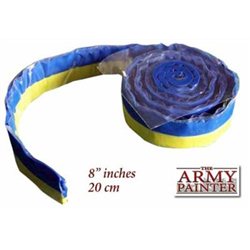

Standard Yellow-Grey Milliput
Price: £ 3.90Standard Yellow-Grey Milliput TWO PART EPOXY PUTTY (113.4gm)Standard Milliput...
Superfine White Milliput
Price: £ 5.99Superfine White Milliput TWO PART EPOXY PUTTY (113.4gm)Superfine White...
Related posts
-
 Do I need to wash my plastic kit?I personally wash all my plastic kits, I use warm soapy water (Washing up liquid) and a light rub over with a nail...
 - What is Milliput?Milliput is a two-part epoxy putty. There are two different colour rolls in a box when these are mixed together it...
- What modelling tools do I need to get started?Most modellers have an extensive tool kit, a tool for every eventuality. But when first starting a scalpel or a...
- How do I remove parts from the sprue?The short answer is carefully. The best way is with a sprue and plastic cutter but always be mindful of exactly...
- Do I need a cutting mat?It is not essential to have a cutting mat, but it is a good idea. It saves getting in trouble with your significant...