Bridge identification signs have been used for many years but didn't become commonplace until around 1999. Their...

Cart 0 Product Products (empty)
No products
Free shipping! Shipping
£ 0.00 Total
Product successfully added to your shopping cart
Quantity
Total
There are 0 items in your cart. There is 1 item in your cart.
Total products (tax incl.)
Total shipping (tax excl.) Free shipping!
Total (tax incl.)
Search Tips
Tips categories
Latest Tips
-
 What is a bridge identification sign?Read more
 -
 How can I make model railway tunnels look more detailed?Read more
To make your model railway tunnels look more detailed and realistic, focus on texture, weathering and scenic...
-
 Did British Railways ever operate ships?Read more
British Railways owned and operated many ships from when it was formed in 1948 until 1984. British Railways inherited...
-
 What is zamak rot (zinc pest)?Read more
Zamak Rot (also known as zinc pest or Mazak rot) is a problem that plagued some early diecast model parts due to...
-
 What are electrofrog points?Read more
Electrofrog points are model railway turnouts with no isolated sections.Regular turnouts require a small plastic...

How much space is needed for a model railway layout?
There are infinite answers to how much space you need for a layout. The most obvious variable here is the scale in which you wish to build your model railway. Less considered factors are what you want to achieve with the finished railway and what shape your layouts footprint should take.
Firstly we will take a look at the scale, this is how small the models are in relation to their full-size real-life prototypes. There are over a dozen different scales to choose from. The most popular are the small N gauge with a scale of 1:160 and the medium-sized 00 or H0 gauges with scales of 1:76 and 1:87 respectively.
There are advantages to both: with N gauge you can cram more model railway into the space you have available whereas the medium-sized 00 and H0 gauges are less fiddly and a lot easier to detail.
The second decision you have to make is what kind of railway scene you would like to create. A mainline recreation will inevitably take up a lot more space than a small dead-end branch line station scene just as it does in real life and then there is the compromise to consider. Are you willing to have unrealistically tight bends or short platforms on your station? One thing is true though, and that is if you are new to the hobby, whatever space you have, you will fill.
The third decision in an endless list of modelling decisions that you will be making is what shape should the footprint of your railway take. There are several different ways that you can construct your railway including an oval of track on a baseboard, a straight run from end to end along a single wall in a room or a full tour of a room taking in every wall of the room on the way, along with just about any other footprint you can dream up.
Only once you have given thought to these considerations can you start to work out how much space you will need for your model railway and the answer will probably be a lot more than you have!
So the best advice would be to turn the question on its head, look at what space you have and then decide on your scale, scene and footprint.
Click here to receive the tips weekly in your mailbox. You can unsubscribe at any time.
Related products
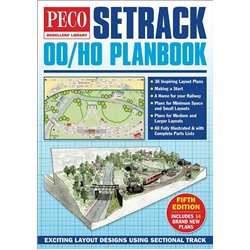
OO/HO Setrack Planbook 5th Edition
Price: £ 3.75This book is the new edition of a PECO bestseller and includes lots of new...
Related posts
-
 Do I need to paint my base boards?I would recommend painting your base board for two reasons: The first being it will seal the base board and prevent...
 - How do I apply static grass?Static grass is best applied using a static grass applicator. There are several on the market and they can apply...
- What is a Diorama?A diorama is three-dimensional scene creating a moment in time, this could be a historical event or a fictional one,...
- What is the best wood for baseboards?The most common wood for baseboards is probably chipboard as this is relatively inexpensive. Plywood is another...
- How to make hills?You can make hills in a variety of ways. The tried and tested way is with chicken wire and papier mache. This is a...