The dictionary defines gauge as "the distance between the two rails on a railway line" and scale as "the scale of a...

Cart 0 Product Products (empty)
No products
Free shipping! Shipping
£ 0.00 Total
Product successfully added to your shopping cart
Quantity
Total
There are 0 items in your cart. There is 1 item in your cart.
Total products (tax incl.)
Total shipping (tax excl.) Free shipping!
Total (tax incl.)
Search Tips
Tips categories
Latest Tips
-
 What is the difference between gauge and scale?Read more
 -
 What is a mitre box?Read more
A mitre box is a metal framework designed to hold an item of building material in place while you saw through it at...
-
 What is a BR Mk1 coach?Read more
The BR Mk1 coach (British Railways Mark 1) was a standard design of railway carriage introduced by British Railways...
-
 What is the difference between 00 and H0?Read more
If you have ever wondered into your local model shop to admire, dream about or even treat yourself to a 00 gauge...
-
 What is the best way to temporarily attach wagon loads?Read more
There are many ways to attach loads to your wagons: Blu Tack, double sided sticky tape and magnets are just a few,...

What is the third rail?
The "third rail" refers to an additional rail that provides electrical power to trains, separate from the two rails that support and guide the train's wheels. This method is commonly used in electric railway systems, particularly in urban and suburban networks where overhead lines might be impractical or visually intrusive. The third rail is typically positioned alongside or between the running rails and is energised with a high voltage, which is collected by a shoe or a contact on the train as it runs along the track.
The third rail system is most commonly associated with direct current (DC) electricity, usually at voltages ranging from 600 to 750 volts. This setup is prevalent in the London Underground, where it has been in use since the early 20th century, providing a reliable and efficient power source for the dense, high-frequency service required in an urban environment. Unlike overhead catenary systems, the third rail does not require tall structures or wires above the train, which can be beneficial in tunnels or areas with low clearance.
However, the third rail system does come with certain limitations and safety concerns. Because it operates at a high voltage and is exposed at ground level, it poses a significant risk to anyone who comes into contact with it. This makes safety precautions vital, such as fencing, warning signs, and rigorous public education campaigns. Additionally, the third rail is more susceptible to obstructions like debris or snow, which can interfere with the electrical connection and disrupt service.
In terms of efficiency, the third rail is generally suited for short to medium-distance rail systems, where the need for high-speed travel is less critical. It is less efficient for long-distance routes due to power losses over greater distances, which is why high-speed trains and long-distance services typically rely on overhead catenary systems instead. Furthermore, the voltage used in third rail systems is lower compared to those in overhead systems, which limits the power available for acceleration and speed.
The third rail system is a key component of many rail networks across the UK and other parts of the world, particularly in densely populated areas where space and infrastructure constraints make other systems less feasible. Its adoption and continued use demonstrate its effectiveness in specific contexts, despite the challenges and risks associated with it.
In summary, the third rail plays a crucial role in the operation of many electric railway systems, especially in urban environments like London. While it has certain limitations, its design and implementation have proven to be effective for the services it supports, providing a critical backbone for some of the busiest rail networks in the world.
Posted in: Best practices
Click here to receive the tips weekly in your mailbox. You can unsubscribe at any time.
Related products
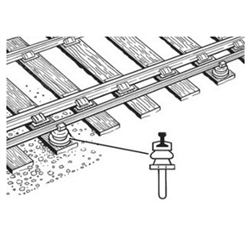
Conductor Rail Chairs, for Code 60 rail
Price: £ 9.10Conductor rail chairs, these accurately detailed mouldings are a slide fit...
Code 60 Flat Bottom Rail Nickel Silver 609mm (x6)
Price: £ 12.25(24in) x 6 For Z Scale and also used as OO Scale Conductor Rail.
Related posts
-
 Do I need a respirator?If you are using an aerosol spray paint you should always use one. Always read the manufacturer’s...
 - How to remove super glue (cyanoacrylate)?Cyanoacrylate is best known as super glue. The best way to remove it is with acetone or an acetone-based product...
- What is the best wood for baseboards?The most common wood for baseboards is probably chipboard as this is relatively inexpensive. Plywood is another...
- How do I stick parts together for a test fit?There are several trains of thought on the best way to secure parts together temporarily. Some suggest using a small...
- How to clean model railways track?There is of course the old tried and tested method, the track rubber which does the job, no railway modeller should...