One of the key challenges you'll face as a military vehicle modeller is capturing that faded, worn appearance that...

Cart 0 Product Products (empty)
No products
Free shipping! Shipping
£ 0.00 Total
Product successfully added to your shopping cart
Quantity
Total
There are 0 items in your cart. There is 1 item in your cart.
Total products (tax incl.)
Total shipping (tax excl.) Free shipping!
Total (tax incl.)
Search Tips
Tips categories
Latest Tips
-
 How do I replicate faded paint on military scale models?Read more
 -
 How do I calculate the space needed for an incline on my model railway layout?Read more
The first thing you need to know when calculating gradients is that it doesn't matter which unit of measurement you...
-
 What is a wagon solebar?Read more
A wagon's solebar is the outer longitudinal beam of its underframe or chassis.Solebars are an integral part of a...
-
 What is quartering in model railway?Read more
When modellers talk about quartering, they are referring to the side-rods on their locomotives being set to the...
-
 What is meant by the term 'kitbashing'?Read more
The term "kitbashing" refers to the practice of modifying or combining different model kits or components to create a...

How do I stick parts together for a test fit?
There are several trains of thought on the best way to secure parts together temporarily.
Some suggest using a small amount of super glue, rubber glue or even PVA glue.
All of these are fine but will leave a glue residue when pulled apart.
Other modellers even drill holes in the parts and insert either plastic or brass rods.The risk of damage to the parts is great.
Personally, I use a product called Tacky Wax and like it says, it is very tacky and made of wax.
The good thing with this is, it allows you to reposition the model parts as many times as you like and when you have finished and ready to glue for the final time, you just have to remove the Tacky Wax with a small amount of warm soapy water.
Click here to receive the tips weekly in your mailbox. You can unsubscribe at any time.
Related products
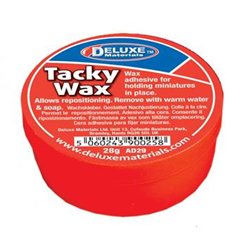
Tacky wax
Price: £ 7.00Tacky wax 28g Wax adhesive for holding miniatures (and especially figures) in...
Related posts
-
 Do I need to wash my plastic kit?I personally wash all my plastic kits, I use warm soapy water (Washing up liquid) and a light rub over with a nail...
 - What is Milliput?Milliput is a two-part epoxy putty. There are two different colour rolls in a box when these are mixed together it...
- What modelling tools do I need to get started?Most modellers have an extensive tool kit, a tool for every eventuality. But when first starting a scalpel or a...
- How do I remove parts from the sprue?The short answer is carefully. The best way is with a sprue and plastic cutter but always be mindful of exactly...
- Do I need a cutting mat?It is not essential to have a cutting mat, but it is a good idea. It saves getting in trouble with your significant...