We often hear modellers refer to their "fiddle yard", but unless you already know what one is, the name doesn't...

Cart 0 Product Products (empty)
No products
Free shipping! Shipping
£ 0.00 Total
Product successfully added to your shopping cart
Quantity
Total
There are 0 items in your cart. There is 1 item in your cart.
Total products (tax incl.)
Total shipping (tax excl.) Free shipping!
Total (tax incl.)
Search Tips
Tips categories
Latest Tips
-
 What is a fiddle yard?Read more
 -
 What is point rodding in model railways?Read more
Point rodding is a system of rods and bars that physically joins the lever of a signal box or ground frame with a set...
-
 What scale is a 28mm figure used by wargamers?Read more
28mm wargaming figures, sometimes referred to as miniatures, are the most popular scale of gaming figures on the...
-
 Why are most diesel locomotives double-ended whereas most steam locomotives were not?Read more
The reason why most diesel locomotives are double-ended, meaning they have a cab and controls at both ends, while...
-
 Is wood better than plastic for modelling?Read more
When it comes to scale modelling, the debate between using wood or plastic is a long-standing one. Both materials...

How can I easily remove dust and dirt from a layout?
Unfortunately, one of the unwanted side effects of modelling is that sometimes our creations can serve as very effective dust and debris traps, or a ready-made metropolis for household spiders. In short, they are very effective at collecting dirt and accumulated debris. Removal of said debris is a perennial problem for most modellers as it is also just as likely that self-inflicted damage may occur in the case of over-vigorous cleaning.
There are a number of options available to modellers that should minimise cleaning-related damage. Careful use of a hobby brush (either damp or dry) can be an effective means of debris removal and is a favoured option for many modellers. Although a useful technique, it might not be the most effective at removing deeply ingrained dirt or dust. Some modellers use aerosol can air dusters which are reasonably cheap and readily available from hardware and provision stores or via the internet. Similarly, airbrush users can use a two-stage airbrush to deliver air to a model. The advantage of using an airbrush is that the user will have some degree of control over the strength of the airflow applied.
Some hobby manufacturers have taken a more direct approach and produced a physical medium that is directly applied to the model to remove dust and grime. Both 'Dust Dabber' by Woodland Scenics and 'Cyber Clean' by Busch work in this way. Both products use a solid sponge-like material that is dabbed onto the model or layout that attracts surface dirt and grime. In both cases, the sticky surface of the material removes deposits from the model but does not leave any residue behind, meaning that with care they can be used on painted surfaces and delicate parts.
Posted in: Best practices
Click here to receive the tips weekly in your mailbox. You can unsubscribe at any time.
Related products
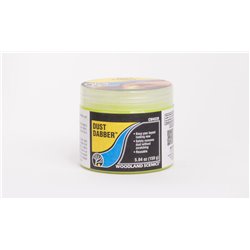
Dust Dabber
Price: £ 7.75Dust DabberKeep your models looking new! This reusable Dabber safely removes...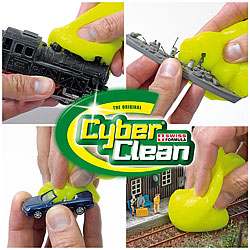
DISC**Cyber Clean
Price: £ 5.99Cyber Clean Model Cleaner - neat and simple to use:Just simply roll over, or...
Related posts
-
 Do I need a respirator?If you are using an aerosol spray paint you should always use one. Always read the manufacturer’s...
 - How to remove super glue (cyanoacrylate)?Cyanoacrylate is best known as super glue. The best way to remove it is with acetone or an acetone-based product...
- What is the best wood for baseboards?The most common wood for baseboards is probably chipboard as this is relatively inexpensive. Plywood is another...
- How do I stick parts together for a test fit?There are several trains of thought on the best way to secure parts together temporarily. Some suggest using a small...
- How to clean model railways track?There is of course the old tried and tested method, the track rubber which does the job, no railway modeller should...