T gauge is the smallest commercially available model railway gauge. It has a scale of either 1:450 or 1:480 and a...

Cart 0 Product Products (empty)
No products
Free shipping! Shipping
£ 0.00 Total
Product successfully added to your shopping cart
Quantity
Total
There are 0 items in your cart. There is 1 item in your cart.
Total products (tax incl.)
Total shipping (tax excl.) Free shipping!
Total (tax incl.)
Search Tips
Tips categories
Latest Tips
-
 What is T gauge in model railways?Read more
 -
 What’s the best way to model abandoned vehicles?Read more
To model abandoned vehicles convincingly, here's a guide tailored to creating realistic effects for your layout: 1....
-
 What is meant by the two-rail wiring principle?Read more
The two-rail wiring principle is a fundamental concept in model railway wiring. It refers to the use of two separate...
-
 What type of equipment is used to recover a derailed train ?Read more
When a train derails, it can be a challenging and complex task to recover it and get it back on track. Specialized...
-
 What are the different ways to apply washes when painting scale models?Read more
As any seasoned modeller will tell you, using washes is an essential technique for adding depth, shading and realism...

How can I accurately position small parts when making a model?
One of the trickiest tasks when model-making can be the positioning of very small or delicate parts. In most instances, modellers will generally use tweezers to achieve this. The problem with exceptionally small parts is they can be difficult to position in the tweezers in the first place. Self-closing tweezers apply a set pressure to any part that they hold and if the pressure is in excess of that required it can result in the tweezers emitting the 'Twang of Death' with the resultant catapulting of parts to the four winds. This generally results in outbursts of colourful language and ensuing cases of 'Housemaid's Knee'.
There are some tool options that can be very effective in allowing modellers to position small parts with precision. Tacky wax is not a glue, rather it is a sticky substance formulated specifically to allow accurate and precise positioning of small parts on models, dioramas or layouts. One other useful benefit it offers is that items can be temporarily positioned and easily removed or relocated later without the need for glue. This can be very useful in the case of temporarily positioning figures on a layout in certain locations, or in holding parts in place whilst adhesives are used to secure them in a particular location.
Gentle Grips are another tool that can be useful in working with small or delicate parts. These are a small pair of tweezers with rubber caps positioned over the ends of the prongs. These can be used to exert gentle pressure sufficient to hold the part safely in place. The rubber caps are non-slip and exert a gentle but firm pressure on the part in question making it a very useful option when dealing with small parts.
Both of these options offer soft but firm control which makes them ideal for handling and positioning a range of items from photo-etch parts to OO/HO or N Gauge figures safely and with precision.
Posted in: Assembling and gluing
Click here to receive the tips weekly in your mailbox. You can unsubscribe at any time.
Related products
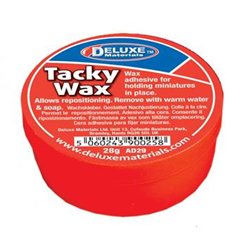
Tacky wax
Price: £ 7.00Tacky wax 28g Wax adhesive for holding miniatures (and especially figures) in...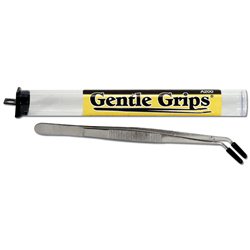
Scenic Accents Gentle Grips
Price: £ 11.50Scenic Accents Gentle GripsFinely hand-painted figures, ideal to bring life...
Related posts
-
 Do I need to wash my plastic kit?I personally wash all my plastic kits, I use warm soapy water (Washing up liquid) and a light rub over with a nail...
 - What is Milliput?Milliput is a two-part epoxy putty. There are two different colour rolls in a box when these are mixed together it...
- What modelling tools do I need to get started?Most modellers have an extensive tool kit, a tool for every eventuality. But when first starting a scalpel or a...
- How do I remove parts from the sprue?The short answer is carefully. The best way is with a sprue and plastic cutter but always be mindful of exactly...
- Do I need a cutting mat?It is not essential to have a cutting mat, but it is a good idea. It saves getting in trouble with your significant...