For best results it is advisable to use a primer as this will stick to the plastic and give a uniform coat of paint...

Cart 0 Product Products (empty)
No products
Free shipping! Shipping
£ 0.00 Total
Product successfully added to your shopping cart
Quantity
Total
There are 0 items in your cart. There is 1 item in your cart.
Total products (tax incl.)
Total shipping (tax excl.) Free shipping!
Total (tax incl.)
Search Tips
Tips categories
Latest Tips
-
 Do I need to use a primer?Read more
 -
 What scale of people should I use on a cake or floral display?Read more
Model figures are used by many creators of wonderful things, whether it be railway layouts, display dioramas, school...
-
 Is it a good idea to use second-hand track?Read more
Personally, I would never use second hand track as you don't really know what you are getting. Over time track will...
-
 Are there alternatives to using scatter when creating surface vegetation?Read more
One of the most satisfying ways to bring a layout or diorama to life is to blend it into some form of natural...
-
 What are my options for motorising a level crossing on my layout ?Read more
Motorising a level crossing can add a realistic touch to the operation of a layout. There are several options...

Are there alternatives to using scatter when creating surface vegetation?
One of the most satisfying ways to bring a layout or diorama to life is to blend it into some form of natural environment. Many modellers will have used bags of scatter to achieve this result. Scatter is a very useful option when bringing life to a layout but it does come with some drawbacks. Inevitably the scattering process uses a lot of material and not all of this will conveniently attach itself to the model. Additionally, over time the adhesive used to attach the scatter can lose its effect causing scatter to be lost.
There are a number of cost-effective options for this process that are both simple and durable. Many manufacturers produce grass and other variants of plantlife substrates in mat and roll forms. The options include seasonal variations on grasses and meadow plant life. These can be cut to size and simply secured to the layout using a small amount of adhesive. Mats are particularly effective for modelling irregular surfaces such as rocky outcroppings where the amount of the desired cover can be cut and applied with relative ease.
In the case of large level surfaces such as a park or garden lawn, it is possible to use a roll specifically for this purpose. A roll is a great option for covering larger areas in that it can be cut to shape and fitted with ease. It also allows the modeller to simply repeat the process when multiple variations of the same effect are required, such as multiple lawns in a village or town.
When modelling a rural scene such as a farm or meadow then differing mat types can be used to create subtle variations in surface vegetation. Although many mats and rolls can easily be used on any layout or diorama, some are gauge specific, so it is always good to check first before purchasing.
Mats and rolls can offer a simple and cost-effective solution to stocking up on large amounts of scatter. When carefully blended they can add stunning visual effects to a wide variety of layouts. Why not give them a go on your next project?
Posted in: Scenery
Click here to receive the tips weekly in your mailbox. You can unsubscribe at any time.
Related products
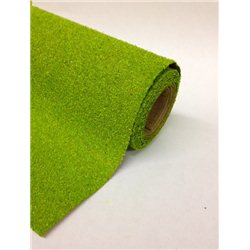
Light Green No. 14 Landscape Mat 1200mm x 600mm...
Price: £ 6.50Simulated Landscape Mats1200mm x 600mm N0.14 landscape mats - Light Green...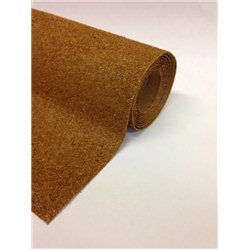
Dark Brown No. 32 Landscape Mat 1200mm x 600mm...
Price: £ 6.50Simulated Landscape Mats1200mm x 600mm N0.32 landscape mats - Dark Brown...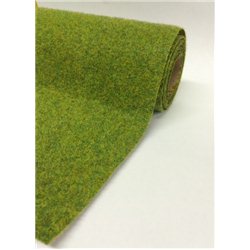
Related posts
-
 Is static grass better than scatter?I use both, separately and together. Static grass comes in various sizes from 0.5mm to 12mm while scatter is...
 - How do I apply static grass?Static grass is best applied using a static grass applicator. There are several on the market and they can apply...
- What colour are tree trunks?Tree trunks are actually grey in colour and not brown as you would think. The next time you are out and about just...
- How to make hills?You can make hills in a variety of ways. The tried and tested way is with chicken wire and papier mache. This is a...
- How do I glue scatter?Select the area where you want the scatter, then apply a layer of PVA glue, sprinkle your grass covering the glue....