We often hear modellers refer to their "fiddle yard", but unless you already know what one is, the name doesn't...

Cart 0 Product Products (empty)
No products
Free shipping! Shipping
£ 0.00 Total
Product successfully added to your shopping cart
Quantity
Total
There are 0 items in your cart. There is 1 item in your cart.
Total products (tax incl.)
Total shipping (tax excl.) Free shipping!
Total (tax incl.)
Search Tips
Tips categories
Latest Tips
-
 What is a fiddle yard?Read more
 -
 What is point rodding in model railways?Read more
Point rodding is a system of rods and bars that physically joins the lever of a signal box or ground frame with a set...
-
 What scale is a 28mm figure used by wargamers?Read more
28mm wargaming figures, sometimes referred to as miniatures, are the most popular scale of gaming figures on the...
-
 Why are most diesel locomotives double-ended whereas most steam locomotives were not?Read more
The reason why most diesel locomotives are double-ended, meaning they have a cab and controls at both ends, while...
-
 Is wood better than plastic for modelling?Read more
When it comes to scale modelling, the debate between using wood or plastic is a long-standing one. Both materials...

How do I use Vallejo Liquid Mask?
Liquid Mask by Vallejo is a liquid medium designed to be used by modellers to mask off areas during painting. It can be applied either by brush or airbrush and dries in about two hours leaving a transparent rubberised surface that will protect surfaces from additional coats of paint. This is particularly useful when painting clear transparent parts such as aircraft cockpit canopies. It can also be used to mark the demarcation lines in specific colour patterns such as camouflage schemes on ships, aircraft or armoured vehicle models.
Liquid Mask can also be cleverly used when a modeller is looking to achieve certain weathering effects such as underlying rust. Liquid Mask can be applied to a model after the initial rust undertone has been painted. This is best achieved in a random manner such as from a segment of foam scouring pad or by flicking a paintbrush with a toothpick. Final layers of paint can then be applied and when these have dried the liquid mask can be carefully removed by a scalpel, toothpick or gentle rubbing of a cloth. This will then reveal the underlying layer of rust and if done carefully it may be possible to leave small amounts of Liquid Mask behind. This can work well with the rust undertone by hinting at bubbling in the paintwork, thus giving a discernible 3D effect and allowing the subsequent paint job to really pop giving a very lifelike finish.
Liquid Mask can also be used in combination with other masking mediums such as masking tape when masking off larger areas. For example in the case of masking off an access panel then the inner edges could be masked off with tape with the rest of the area covered with Liquid Mask. When it is time to remove the protective mask simply peel back the edge of the masking tape with a scalpel and the Liquid Mask will be removed at the same time. This technique has obvious advantages when used on awkward shapes or uneven surfaces which may otherwise require masking tape to be cut to specific shapes which can be time-consuming and difficult to apply.
Posted in: Painting
Click here to receive the tips weekly in your mailbox. You can unsubscribe at any time.
Related products
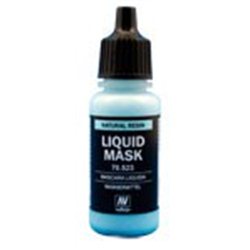
Model Color - Liquid Mask
Price: £ 3.00Model Color - Liquid Mask Used to reserve areas which are to remain...
Related posts
-
 Do I need to use a primer?For best results it is advisable to use a primer as this will stick to the plastic and give a uniform coat of paint...
 - What is weathering?Weathering is a painting technique used by modellers to create the appearance of dirt and grime and even damage to...
- How do I clean brushes used with enamel paint?Enamel paint is solvent based, so trying to wash in water will not work, you need to use white spirit. It is...
- How do I fill holes in a model?There are many products on the market for filling holes: There are plastic putties straight out of the tube, there...
- What is the best size paintbrush?This would depend on what you are painting as paint brushes come in various shapes and sizes. I would say for...