In simple terms, no, a gloss surface is not always needed for the application of decals but this is not a...

Cart 0 Product Products (empty)
No products
Free shipping! Shipping
£ 0.00 Total
Product successfully added to your shopping cart
Quantity
Total
There are 0 items in your cart. There is 1 item in your cart.
Total products (tax incl.)
Total shipping (tax excl.) Free shipping!
Total (tax incl.)
Search Tips
Tips categories
Latest Tips
-
 Do I need to apply a gloss surface to my models before applying decals?Read more
 -
 Can you fit a Train-Tech sound capsule to an N gauge model?Read more
Fitting any component inside an N gauge body shell can be challenging, and whether fitting a decoder, figures or even...
-
 How long does it take for enamel paint to fully dry?Read more
Most enamel model paints will be fully dried (cured) between 48 and 72 hours after application.Of course, there...
-
 What is a backscene?Read more
A backscene is a proportionately sized photograph or painting that sits upright at the back of a model railway layout...
-
 What is the difference between a traditional DC motor and a coreless motor?Read more
DC motors such as the ones in your model engines, work on the principle of an armature (made of several wire coils to...

What is a CCT van?
The term CCT van stands for 'Covered Carriage Truck'. These Railway vans were designed specifically to carry motor vehicles. First built in the 1950s these vans were subsequently banned by Motorail in the mid-1960s.
Clearances for carrying motor vehicles were inevitably tight, added to which loading and unloading via the end doors was a time consuming and manpower intensive process. Many vehicles were subsequently used for the carriage of parcels and mail.
Just over 800 were built and individual vans have been preserved around the UK with examples operated by the Bluebell Railway in Sussex and the North Norfolk Railway.
Posted in: Rolling stock
Click here to receive the tips weekly in your mailbox. You can unsubscribe at any time.
Related products
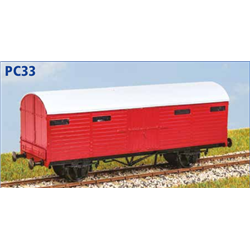
LMS 4-wheel CCT
Price: £ 22.90LMS 4-wheel CCT 125 vehicles of this design were built in 1935-37, with...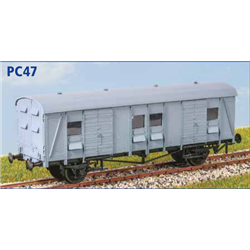
Parkside Dundas PC47 - SR Cct Parcel Van...
Price: £ 22.90SR Cct Parcel Van - Plywood Sides - OO unpainted plastic kitComes with metal...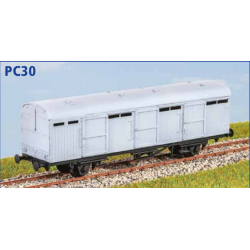
LNER Extra Long Cct 4 Wheel - OO plastic kit
Price: £ 22.90LNER Extra Long Cct 4 Wheel - OO unpainted plastic kitComes with metal...
Related posts
-
 How to weight my model so it does not tip?For wargaming figures, a small coin or washer glued to the under side of the base will usually to do the job. This...
 - Is Bachmann compatible with Hornby?Yes, any OO scale loco, wagon or coach will work on any OO scale track, regardless of brand. Couplings are also...
- What are tension lock couplings?Tension lock couplings are the standard couplings for model trains in the UK. These are the ones we all know from...
- How do I test the width between the wheels of my engines?The best way to check the wheels of your locomotives is to use a tool called a back to back gauge. They are...
- How do I clean the wheels of my engine?One easy way is to get yourself a Peco cleaning kit containing a wire brush, wheel scraper, foam cradle and oil. The...