The hot wire foam and polystyrene cutter is a tool designed specifically to allow modellers to cut foam, polystyrene...

Cart 0 Product Products (empty)
No products
Free shipping! Shipping
£ 0.00 Total
Product successfully added to your shopping cart
Quantity
Total
There are 0 items in your cart. There is 1 item in your cart.
Total products (tax incl.)
Total shipping (tax excl.) Free shipping!
Total (tax incl.)
Search Tips
Tips categories
Latest Tips
-
 What is a hot wire foam and polystyrene cutter?Read more
 -
 What is the best way to store paint?Read more
Always store paint in a cool dry place, or room temperature, do not leave in direct sunlight especially aerosols....
-
 What are tension lock couplings?Read more
Tension lock couplings are the standard couplings for model trains in the UK. These are the ones we all know from...
-
 In model scenery construction, what are profiles?Read more
'Profiles' are a part of the skeleton that you would build when creating a model hill on your layout. Specifically,...
-
 As a model aircraft enthusiast, what tools should I have?Read more
As a model aircraft enthusiast, having the right tools is essential for a successful and enjoyable building...

What is 'arc' on a turnout?
When choosing a turnout or curve for your model railway, you may have noticed an 'arc' measurement alongside its radius. But what does this mean?
An arc is defined as a part of a circumference. When used as a measurement on a model railway track, an arc is a way of expressing the degree of course change the track makes. So a curve or turnout with an arc of 45 degrees will result in a route diverging from its original heading by 45 degrees. Connect two tracks with an arc of 45 degrees and the route will turn at a right angle (90 degrees). Connect eight 45 degree arc curves and the route will turn a full 360, and so on.
The 'arc' measurement is particularly useful for modellers trying to calculate which sections of track are required to achieve desired track plans. The most common arc calculation used by railway modellers is when attempting to return a track's route to straight ahead after a turnout. In this instance, a turnout with an arc of 45 degrees will simply require a curved section with a matching 45 degrees arc to get back on course with a heading parallel to the primary route.
Arc also helps modellers understand how many curved sections make up a complete circle of track. This is especially useful when using Setrack with larger radii as these tend to have smaller arcs.
Posted in: Tracks
Click here to receive the tips weekly in your mailbox. You can unsubscribe at any time.
Related products
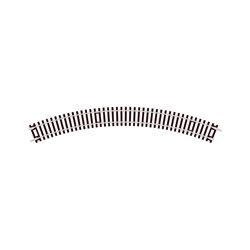
No.1 Radius Double Curve, 371mm (14⅝in) radius
Price: £ 4.80No.1 Radius Double Curve, 371mm (14⅝in) radius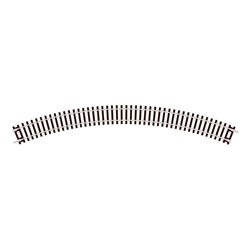
No.2 Radius Double Curve, 438mm (17¼in) radius
Price: £ 5.10No.2 Radius Double Curve, 438mm (17¼in) radius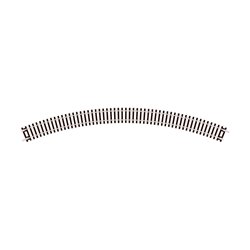
No.3 Radius Double Curve, 505mm (19⅞in) radius
Price: £ 5.10No.3 Radius Double Curve, 505mm (19⅞in) radius
Related posts
-
 How to clean model railways track?There is of course the old tried and tested method, the track rubber which does the job, no railway modeller should...
 - Is Peco track and Hornby track compatible?Peco Setrack and Peco Streamline are compatible with Hornby track as they all share the same gauge width of 16.5mm....
- How often should I clean my track?This a hard question to answer. There are no hard and fast rules about how often you should clean the track. Bear in...
- How do I cut flexible track?Once upon a time I would have said a newly bladed junior hacksaw and some warding files, but these days I would have...
- How many pieces of curved track do I need to make a circle?As we all know it takes 360 degrees to create a circle, a standard curve is 22.5 degrees and a double curve is 45...