Stretched sprue is a modelling technique frequently used by modellers that can be utilised to create a number of...

Cart 0 Product Products (empty)
No products
Free shipping! Shipping
£ 0.00 Total
Product successfully added to your shopping cart
Quantity
Total
There are 0 items in your cart. There is 1 item in your cart.
Total products (tax incl.)
Total shipping (tax excl.) Free shipping!
Total (tax incl.)
Search Tips
Tips categories
Latest Tips
-
 How can I use stretched sprue in modelling?Read more
 -
 What is a fogman?Read more
A 'fogman' was a railway worker tasked with laying detonators (fog signals) on railway tracks during snowy, foggy or...
-
 What are Heljan?Read more
Heljan is a Danish company renowned in the model railway community for its high-quality model trains and accessories....
-
 What is model railway ballast inlay?Read more
Ballast inlays are sponge strips designed for placement under model railway track to cushion it whilst replicating...
-
 What is a tinplate model?Read more
Tinplate models were mainly produced before we had the ability to manufacture plastic injection-moulded models....

How do I separate glued plastic parts?
There are many occasions when modellers need to strip down a model or reclaim parts that have been previously glued together, and the temptation is often to apply a little force, maybe combined with a spot of sharp knife blade wriggling, to try and separate parts. But before you set about half destroying the very item you wish to reuse or restore, try these methods first.
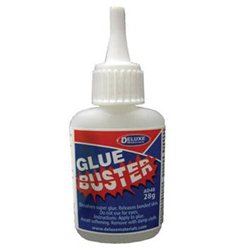
Firstly, there is the chemical approach. Products such as Deluxe Materials Glue Buster are specifically designed to loosen cyanoacrylate (super glue). It is always advisable to test on an unseen part of your model first when using a chemical of any kind to check that there is no reaction, but otherwise, such products are excellent for getting you out of a sticky situation.
The second approach is heating. Warming the join on a model with a hairdryer can soften the plastic and affect the chemical bond originally formed by the glue. This method is not quick and requires you to apply heat for several minutes to achieve any effect, but a little perseverance may well separate your model, for free!
Posted in: Assembling and gluing
Click here to receive the tips weekly in your mailbox. You can unsubscribe at any time.
Related products
Related posts
-
 Do I need to wash my plastic kit?I personally wash all my plastic kits, I use warm soapy water (Washing up liquid) and a light rub over with a nail...
 - What is Milliput?Milliput is a two-part epoxy putty. There are two different colour rolls in a box when these are mixed together it...
- What modelling tools do I need to get started?Most modellers have an extensive tool kit, a tool for every eventuality. But when first starting a scalpel or a...
- How do I remove parts from the sprue?The short answer is carefully. The best way is with a sprue and plastic cutter but always be mindful of exactly...
- Do I need a cutting mat?It is not essential to have a cutting mat, but it is a good idea. It saves getting in trouble with your significant...