A single-action airbrush is a useful tool in scale modelling, especially if you're looking for a simple yet effective...

Cart 0 Product Products (empty)
No products
Free shipping! Shipping
£ 0.00 Total
Product successfully added to your shopping cart
Quantity
Total
There are 0 items in your cart. There is 1 item in your cart.
Total products (tax incl.)
Total shipping (tax excl.) Free shipping!
Total (tax incl.)
Search Tips
Tips categories
Latest Tips
-
 What is a single action airbrush?Read more
 -
 How do I glue photoetch parts?Read more
There are many types of glue available to modellers, all of which are good at adhering to different materials. But...
-
 What is a back to back gauge?Read more
A back to back gauge is an instrument for measuring and setting up the distance between wheels on an axle of a model...
-
 How can I model Verdigris and Patination on building roofs and other structures?Read more
Many of the most famous landmarks and buildings worldwide are noticeable for having a distinctive bluish-green colour...
-
 What is HOf?Read more
H0f (or H0f Feldbahn) is a specific scale within model railways, representing a blend of two key characteristics: the...

What is the difference between a traditional DC motor and a coreless motor?
DC motors such as the ones in your model engines, work on the principle of an armature (made of several wire coils to create a series of electromagnets) spinning around inside a casing that has regular magnets placed around its inner wall. The interaction between the electronically magnetised armature and the static magnets of the casing produces movement and a few cogs later, your model trundles down the tracks.
Both coreless and regular motors work on roughly this principle. What is different though is how the wire coils that create the electromagnets are supported to create their operational shape. In a regular motor, the wire will be wrapped around an iron framework specifically designed to create the shapes necessary to act as an electromagnet, however, a coreless motor needs no such framework, this is due to the wire coils (windings) being woven into a honeycomb pattern to create a self-supporting cylinder. The strength of the cylinder is often enhanced with epoxy but the lack of the iron framework (core) is what gives this type of motor its name.
The advantages of coreless motors are less friction, resistance and weight, this is due not only to the omittance of the iron core but also to advances in the materials used to construct key components of the motor. These reductions in stress to the motor generally result in a longer lifespan for coreless motors. Another advantage of coreless motors is that there can't be any magnetic interference between a core and a casing's static magnets which on regular motors can sometimes require your loco needing a small shove to get it going should it have been parked with the motor unluckily in a certain stage of its rotation, for this same reason you should notice that coreless motors run more smoothly and quietly too.
The downside of coreless motors is that they can't be serviced. As most coreless motors are likely to be in sealed casings when they're worn your only option is to replace the motor whereas older motors can usually be kept running with a little knowhow for decades.
Posted in: Power and control
Click here to receive the tips weekly in your mailbox. You can unsubscribe at any time.
Related products
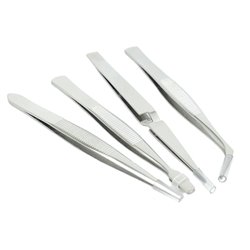
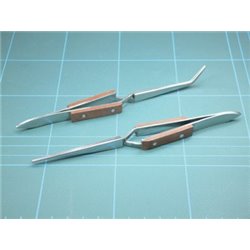
Self Closing Tweezer Straight Insulated Handles...
Price: £ 3.50Self Closing Tweezer Straight Insulated Handles - 6.5 inch
Related posts
-
 Can a "DCC ready" train be used on analogue?Yes, you can use a DCC ready train on your analogue layout. DCC ready just means that the train has been factory...
 - Is it difficult to fit a DCC decoder in to a DCC ready engine?In theory, it should be easy as the whole idea of being DCC Ready is to simplify the process. The first time I did...
- What is 7/0.2 wire?7/02 wire is a wire made of 7 strands of 0.2mm wire. Stranded wire has the advantage of being flexible while solid...
- Is an N Gauge controller compatible with OO Gauge?Yes, an N Gauge controller is compatible with OO gauge trains. You may have to change the power clip to the track...
- Is stranded wire better than solid wire?In my experience, stranded wire is preferable over solid wire. Stranded wire is more flexible than solid core wire,...