Semaphore signals are an important part of any model railway layout as they help to control the movement of trains...

Cart 0 Product Products (empty)
No products
Free shipping! Shipping
£ 0.00 Total
Product successfully added to your shopping cart
Quantity
Total
There are 0 items in your cart. There is 1 item in your cart.
Total products (tax incl.)
Total shipping (tax excl.) Free shipping!
Total (tax incl.)
Search Tips
Tips categories
Latest Tips
-
 Where should I position semaphore signals on my layout?Read more
 -
 How can I add a curve to a Photo Etch part without damaging it?Read more
Photo-Etch, sometimes referred to as PE parts are thin brass parts that allow small or fine detail components to be...
-
 What is On30?Read more
On30, also known as O scale narrow gauge, is a popular model railway scale in which models are built at a ratio of...
-
 Why are most diesel locomotives double-ended whereas most steam locomotives were not?Read more
The reason why most diesel locomotives are double-ended, meaning they have a cab and controls at both ends, while...
-
 Under what circumstances should I consider using a Capacitor Discharge Unit (CDU) with a Point Motor?Read more
A Capacitor Discharge Unit (CDU) is a device that can be used in conjunction with a point motor in model railways to...

Is it difficult to fit a DCC decoder in to a DCC ready engine?
In theory, it should be easy as the whole idea of being DCC Ready is to simplify the process.
The first time I did this, it took me less than five minutes however it will depend on where the socket for the DCC decoder has been placed. Sometimes they can be inside the body of the loco sitting on the chassis, some can be behind the smokebox door or even in the tender.
The service sheet from the engine will tell you where it is and how to access it. You may have to remove screws but overall it should be straightforward.
If you are unsure, your local model shop will be able to provide advice.
Posted in: Power and control
Click here to receive the tips weekly in your mailbox. You can unsubscribe at any time.
Related products
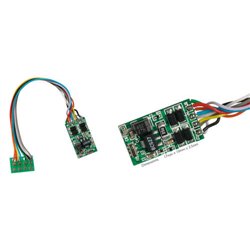
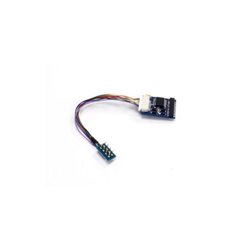
OMNI Decoder - 21 & 8 Pin Decoder
Price: £ 20.95OMNI Decoder - 21 & 8 Pin Decoder A really versatile decoder for use with...
Related posts
-
 Can a "DCC ready" train be used on analogue?Yes, you can use a DCC ready train on your analogue layout. DCC ready just means that the train has been factory...
 - What is 7/0.2 wire?7/02 wire is a wire made of 7 strands of 0.2mm wire. Stranded wire has the advantage of being flexible while solid...
- Is an N Gauge controller compatible with OO Gauge?Yes, an N Gauge controller is compatible with OO gauge trains. You may have to change the power clip to the track...
- Is stranded wire better than solid wire?In my experience, stranded wire is preferable over solid wire. Stranded wire is more flexible than solid core wire,...
- Is electricity on a model train track dangerous?Electricity is inherently dangerous and should always be treated with respect. But with model railways the voltage...