On the real railway line, the ballast would have come from a local quarry so the colour would reflect this. The...

Cart 0 Product Products (empty)
No products
Free shipping! Shipping
£ 0.00 Total
Product successfully added to your shopping cart
Quantity
Total
There are 0 items in your cart. There is 1 item in your cart.
Total products (tax incl.)
Total shipping (tax excl.) Free shipping!
Total (tax incl.)
Search Tips
Tips categories
Latest Tips
-
 What colour is ballast?Read more
 -
 How tall should trees be in N gauge?Read more
Trees come in all shapes and sizes, some you can stand under and not be able to reach the bottom branch, some bottom...
-
 How can I best create a revetment for a World War II aircraft dispersal diorama ?Read more
Creating a revetment for a World War II aircraft dispersal can add a realistic touch to a diorama. A revetment is a...
-
 What is a Wickham Trolley?Read more
A Wickham Trolley is a small railway maintenance vehicle once widely used across Britain's railways. Built by D...
-
 Do I need to use a primer?Read more
For best results it is advisable to use a primer as this will stick to the plastic and give a uniform coat of paint...

How powerful a soldering iron do I need?
Soldering irons are a little bit like the children's story "Goldilocks and the three bears": some are too hot, some are too cold and some are just right, but which is which when it comes to modelling and why?
An entry-level soldering iron will be rated at around 15-20 watts, this is about as basic as it gets and the price-tag will reflect this. Soldering irons in this range are intended for soldering a few wires together, a toolbox must-have if you like for the occasional DIY project, it will get hot enough to melt solder (around 180 degrees centigrade), but, it will take its time and that could become tiresome if you are planning to do a lot of soldering during the construction of your layout.
The next level up soldering iron is rated at around 30 watts, these tools are more powerful and desirable if soldering is to become a regular occurrence. The biggest advantage of these more powerful irons is that they are more effective at heating surfaces quickly and evenly which will create a better join.
The ultimate in soldering irons will have thermostatic control, this will not only allow you to undertake regular soldering tasks, but also more advanced projects such as the construction of white-metal kits (which require a special low-temperature solder to avoid melting the kit) or higher temperature projects involving copper.
For most modellers though, a good quality mid-range soldering iron (30 Watts) will provide you with everything that you need to successfully wire your track, signals and lights.
Click here to receive the tips weekly in your mailbox. You can unsubscribe at any time.
Related products
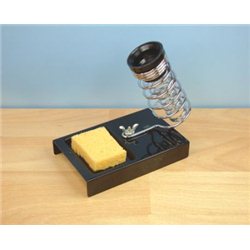
Soldering stand
Price: £ 5.95Soldering stand Features a heavy base, and tip cleaning sponge.Suitable for...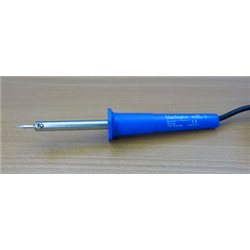
Economy 30 watt Soldering Iron with fine...
Price: £ 7.95Economy 30 watt Soldering Iron with fine pointed tip
Related posts
-
 Do I need to wash my plastic kit?I personally wash all my plastic kits, I use warm soapy water (Washing up liquid) and a light rub over with a nail...
 - What is Milliput?Milliput is a two-part epoxy putty. There are two different colour rolls in a box when these are mixed together it...
- What modelling tools do I need to get started?Most modellers have an extensive tool kit, a tool for every eventuality. But when first starting a scalpel or a...
- How do I remove parts from the sprue?The short answer is carefully. The best way is with a sprue and plastic cutter but always be mindful of exactly...
- Do I need a cutting mat?It is not essential to have a cutting mat, but it is a good idea. It saves getting in trouble with your significant...