On the real railway line, the ballast would have come from a local quarry so the colour would reflect this. The...

Cart 0 Product Products (empty)
No products
Free shipping! Shipping
£ 0.00 Total
Product successfully added to your shopping cart
Quantity
Total
There are 0 items in your cart. There is 1 item in your cart.
Total products (tax incl.)
Total shipping (tax excl.) Free shipping!
Total (tax incl.)
Search Tips
Tips categories
Latest Tips
-
 What colour is ballast?Read more
 -
 How tall should trees be in N gauge?Read more
Trees come in all shapes and sizes, some you can stand under and not be able to reach the bottom branch, some bottom...
-
 How can I best create a revetment for a World War II aircraft dispersal diorama ?Read more
Creating a revetment for a World War II aircraft dispersal can add a realistic touch to a diorama. A revetment is a...
-
 What is a Wickham Trolley?Read more
A Wickham Trolley is a small railway maintenance vehicle once widely used across Britain's railways. Built by D...
-
 Do I need to use a primer?Read more
For best results it is advisable to use a primer as this will stick to the plastic and give a uniform coat of paint...

What is a model railway baseboard?
When railway modellers refer to a baseboard, they are talking about the large flat board on which their railway tracks are permanently attached to.
The purpose of a baseboard is to provide a solid and permanent foundation on which a model railway and its scenery can be constructed. It is possible to connect tracks and operate trains without a baseboard, however, most modellers will want to operate their models within a realistic diorama, and for that, a baseboard will form the foundations.
Baseboards can vary in their complexity and shape, some can be as rudimentary as a 6x4 foot sheet of plywood on the floor, whilst others can be constructed by attaching a flat sheet of wood to a framework and then attaching legs or other support to the framework in order to raise the whole layout off the ground. Baseboards can also adopt any footprint that the modeller desires, whether it be a long and thin design such as along an outer wall or around the full perimeter of a room, or a solid rectangular shaped board in the middle of a room, there are no rules when it comes to a baseboard's footprint other than what is physically possible within the space where the layout is to be constructed.
Some baseboards even have numerous vertical levels facilitating flyovers, raised sections or multi-level layouts, with this in mind, a lot of thought needs to go into what type of layout is to be achieved before baseboard construction begins.
Other considerations to give to a baseboard's design include what weight it will have to support, how much you will want to deaden the sound of your train's operation and what point motors or switches etc will require countersinking into the board, all of these things will affect what materials you use to construct your baseboard and how thick it needs to be. You should also consider if you need a baseboard design that will allow you to separate sections of baseboard for transportation or storage requirements as this will be fundamental to its design. All of these things will have a bearing on the materials and methods that you use to construct your baseboard.
Ultimately, a lot of modellers will agree that the planning and construction of a baseboard is the most important aspect of building a model railway layout.
Click here to receive the tips weekly in your mailbox. You can unsubscribe at any time.
Related products
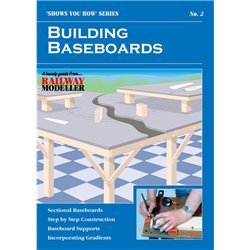
Building Baseboards
Price: £ 1.00Book "Shows You How" - No 2 - Building Baseboards The Peco 'Shows You How'...
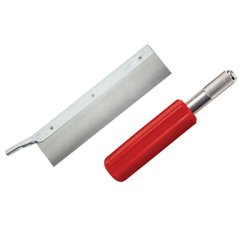
Razor saw set handle + 1 blade
Price: £ 13.20Razor saw set handle + 1 blade Includes heavy duty K5 hobby knife handle, a...
Related posts
-
 Do I need to paint my base boards?I would recommend painting your base board for two reasons: The first being it will seal the base board and prevent...
 - How do I apply static grass?Static grass is best applied using a static grass applicator. There are several on the market and they can apply...
- What is a Diorama?A diorama is three-dimensional scene creating a moment in time, this could be a historical event or a fictional one,...
- What is the best wood for baseboards?The most common wood for baseboards is probably chipboard as this is relatively inexpensive. Plywood is another...
- How to make hills?You can make hills in a variety of ways. The tried and tested way is with chicken wire and papier mache. This is a...