Once you have made your river leading to the edge of your cliff, you will need to measure the distance from the top...

Cart 0 Product Products (empty)
No products
Free shipping! Shipping
£ 0.00 Total
Product successfully added to your shopping cart
Quantity
Total
There are 0 items in your cart. There is 1 item in your cart.
Total products (tax incl.)
Total shipping (tax excl.) Free shipping!
Total (tax incl.)
Search Tips
Tips categories
Latest Tips
-
 How to make a waterfall?Read more
 -
 Are building smoke generators different to locomotive ones?Read more
Building smoke generators are different from locomotive ones in two main areas, size and voltage.Smoke generators...
-
 What is meant by 'Bringing life to your layout or scene'?Read more
Often, railway modellers talk about the importance of bringing their scene to life, but what does this mean? and why...
-
 In simple terms what is tabletop gaming?Read more
Tabletop gaming is a form of gaming where players gather around a table and use physical game pieces, such as...
-
 How can I best achieve the look of desert sand on a layout or diorama ?Read more
Achieving the realistic look of desert sand on a layout or diorama can be a fun and rewarding project. There are a...

What is a railway turntable?
A turntable is a means of turning your engine around.
An example of this would be, if you have several engine sheds at the end of your layout, you would have track coming from each of your sheds leading up to the turntable. When you drive your loco on to the turntable you can then revolve the turntable 180 degrees and reverse your loco on to the correct track for that engines shed.
You could also use a turntable on an end to end layout for turning the engine for its return trip.
In OO gauge, there are prebuilt turntables available from companies such as Peco or Hornby or for the hardcore modeller there is a plastic kit from Dapol that you can make yourself.
The Hornby turntable is motorised, but the others are not. There are motor kits available to fully motorise them though.
Just bear in mind that there are different size turntables, so if you want to turn your loco and tender, you will need a larger turntable to accommodate the tender.
Click here to receive the tips weekly in your mailbox. You can unsubscribe at any time.
Related products
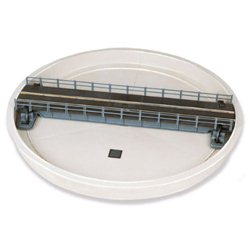
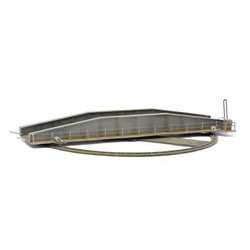
Turntable (Dapol - Kitmaster)
Price: £ 11.10Turntable, HO/OO scale Turntable pit-rail diameter 26cm - Turntable bridge...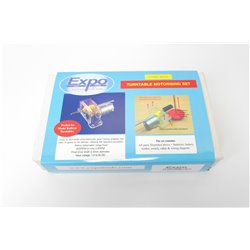
Turntable motorising kit
Price: £ 29.95Turntable motorising kit Contains: Gearbox, shaft, batteries, battery holder,...
Related posts
-
 Do I need to paint my base boards?I would recommend painting your base board for two reasons: The first being it will seal the base board and prevent...
 - How do I apply static grass?Static grass is best applied using a static grass applicator. There are several on the market and they can apply...
- What is a Diorama?A diorama is three-dimensional scene creating a moment in time, this could be a historical event or a fictional one,...
- What is the best wood for baseboards?The most common wood for baseboards is probably chipboard as this is relatively inexpensive. Plywood is another...
- How to make hills?You can make hills in a variety of ways. The tried and tested way is with chicken wire and papier mache. This is a...