How big is your farm? If your farm is predominantly dairy cattle, then you may only have 50 sheep however if your...

Cart 0 Product Products (empty)
No products
Free shipping! Shipping
£ 0.00 Total
Product successfully added to your shopping cart
Quantity
Total
There are 0 items in your cart. There is 1 item in your cart.
Total products (tax incl.)
Total shipping (tax excl.) Free shipping!
Total (tax incl.)
Search Tips
Tips categories
Latest Tips
-
 How big is a flock of sheep?Read more
 -
 What is the difference between bullhead and flat-bottom rail?Read more
From a modeller's perspective, there is no practical difference between bullhead and flat-bottom rail. The existence...
-
 My PVA glue won't flow from the bottle, should I replace it?Read more
There is no need to replace the bottle, it is more than likely a build-up of dry glue inside the nozzle. This is a...
-
 What is the British Rail early emblem?Read more
In 1948 the railways, buses, ports, canals and road haulage companies were nationalised and were to be operated by...
-
 What is the steepest gradient I can use on my model railway layout?Read more
Gradient, is often displayed using a height measurement followed a distance measurement. For example, a 1 in 100...

Is it a good idea to use second-hand track?
Personally, I would never use second hand track as you don't really know what you are getting.
Over time track will wear and tarnish and may even rust (for very old track made of steel) and its conductivity may become diminished even after giving it a good clean.
Visually some sleepers may be damaged or some paint may have been used on part of the track.
Even cleaning it does not really make sense, as it takes maybe 10 to 15 minutes to thoroughly clean the track and even then you are not sure some conductivity will not be lost. If you value your time, it is cheaper to buy new track.
Another potential issue is old track can be twisted, bent or otherwise not correctly set any more. If the track was removed from another layout, some ballast may be stuck to it which may also cause running issues.
So, I always replace old track with new to make for a smoother running track.
Click here to receive the tips weekly in your mailbox. You can unsubscribe at any time.
Related products
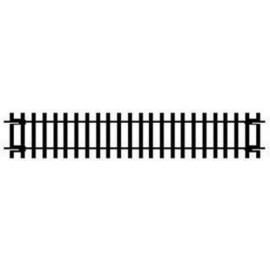
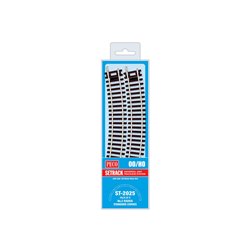
No.2 Radius Standard Curve, 438mm (17¼in)...
Price: £ 31.70No.2 Radius Standard Curve, 438mm (17¼in) radius - pack of 8
Double Straight, 335mm (13 3/16 in) long x8
Price: £ 32.30Double Straight, 168mm (6⅝in) long - pack of 8
Related posts
-
 Do I need a respirator?If you are using an aerosol spray paint you should always use one. Always read the manufacturer’s...
 - How to remove super glue (cyanoacrylate)?Cyanoacrylate is best known as super glue. The best way to remove it is with acetone or an acetone-based product...
- What is the best wood for baseboards?The most common wood for baseboards is probably chipboard as this is relatively inexpensive. Plywood is another...
- How do I stick parts together for a test fit?There are several trains of thought on the best way to secure parts together temporarily. Some suggest using a small...
- How to clean model railways track?There is of course the old tried and tested method, the track rubber which does the job, no railway modeller should...