It's not very often that it happens, but occasionally you may get a DCC locomotive that runs in the opposite...

Cart 0 Product Products (empty)
No products
Free shipping! Shipping
£ 0.00 Total
Product successfully added to your shopping cart
Quantity
Total
There are 0 items in your cart. There is 1 item in your cart.
Total products (tax incl.)
Total shipping (tax excl.) Free shipping!
Total (tax incl.)
Search Tips
Tips categories
Latest Tips
-
 Why is my DCC locomotive running in the wrong direction?Read more
 -
 What is a model railway controller?Read more
A model railway controller, often referred to as a controller or power pack, is an essential device used in model...
-
 Why do only some modellers use a CDU for point motors?Read more
There are several reasons why a modeller may choose to use a CDU (Capacitor Discharge Unit) to provide power to their...
-
 What is a B4 bogie?Read more
Bogies are an independent framework that supports the wheelsets on a railway locomotive, coach or some larger wagons....
-
 When weathering, is an airbrush or a regular brush best?Read more
When weathering, many modellers favour an airbrush over a regular paintbrush for the bulk of the work. But as we...

Is a 21 pin DCC decoder better than an 8-pin decoder?
Surely more is always better, so a 21 pin decoder is bound to be better than an 8 pin decoder? Actually, the answer is not that straightforward.
With more pins, a 21 pin DCC decoder will be able to manage more functions than an 8 pin decoder. Functions can be anything but are usually lights or similar. An 8 pin decoder will be able to control up to 3 functions while a 21 pin decoder can do 6 functions as well as a speaker and stay alive capabilities.
So, if you want sound, you need a 21 pin decoder.
If you do not want sound, an 8 pin decoder is likely to be enough for your needs.
Bear in mind the choice may not even be yours if you do not want to hardwire and solder the decoder: the decision will be made by the socket inside the engine.
Posted in: Power and control
Click here to receive the tips weekly in your mailbox. You can unsubscribe at any time.
Related products
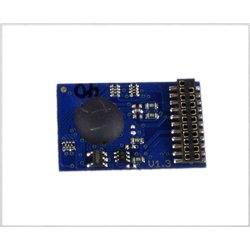
E-Z Command 0.7 Amp 3 Function 21 Pin
Price: £ 18.0021-pin 3-function 2-sided 1A decoder with back EMF for slow running DCC...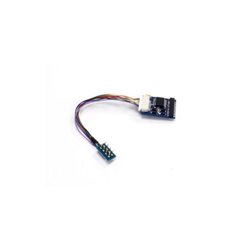
OMNI Decoder - 21 & 8 Pin Decoder
Price: £ 20.95OMNI Decoder - 21 & 8 Pin Decoder A really versatile decoder for use with...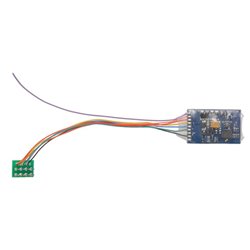
0.9 Amp 4 Function 8 Pin DCC Decoder featuring...
Price: £ 27.950.9 Amp 4 Function 8 Pin DCC Decoder featuring RailComPlus®
Related posts
-
 Can a "DCC ready" train be used on analogue?Yes, you can use a DCC ready train on your analogue layout. DCC ready just means that the train has been factory...
 - Is it difficult to fit a DCC decoder in to a DCC ready engine?In theory, it should be easy as the whole idea of being DCC Ready is to simplify the process. The first time I did...
- What is 7/0.2 wire?7/02 wire is a wire made of 7 strands of 0.2mm wire. Stranded wire has the advantage of being flexible while solid...
- Is an N Gauge controller compatible with OO Gauge?Yes, an N Gauge controller is compatible with OO gauge trains. You may have to change the power clip to the track...
- Is stranded wire better than solid wire?In my experience, stranded wire is preferable over solid wire. Stranded wire is more flexible than solid core wire,...