Building a Metcalfe kit is a great way to gain modelling experience. Building one should not be feared because they...

Cart 0 Product Products (empty)
No products
Free shipping! Shipping
£ 0.00 Total
Product successfully added to your shopping cart
Quantity
Total
There are 0 items in your cart. There is 1 item in your cart.
Total products (tax incl.)
Total shipping (tax excl.) Free shipping!
Total (tax incl.)
Search Tips
Tips categories
Latest Tips
-
 How do I build a Metcalfe kit?Read more
 -
 What is an electromagnetic de-coupler and how would it be used?Read more
An electromagnetic de-coupler is a device used in model railways to separate train carriages without physically...
-
 What to do when plastic cement doesn't cement!Read more
Plastic cement is a formula that temporarily softens and melts the surface of most plastics. This makes it very...
-
 What are open spoke wheels?Read more
Open spoke wheels were a type of early railway wheel that featured double spokes, this type of wheel was commonly...
-
 How can I wash off acrylic paint from unwanted places?Read more
Sometimes, we spend more time trying to remove paint than we do applying it in the first place. Whether it is because...

Can I create my own decals?
Regardless of the subject matter, many model kits are supplied with decals that can be applied to the finished model. Additionally, there is a wide-ranging aftermarket providing additional decal options for modellers. However, on occasions, there may be a need to create bespoke decals, either because the subject matter has not been produced or perhaps to replace old or damaged decals that would be otherwise difficult to source.
Luckily, there are a number of options available when it comes to creating bespoke decals. One option is to use specific decal paper. This is one area where the world of modelmakers overlaps with the realms of other general hobbyists. A number of companies have produced ink-jet water slide decal paper. The required subject can be created on a PC or laptop in either a word processor or a specific image manipulation program. Once produce this can then be sized accordingly and printed. It then acts like a normal decal, in that brief immersion in water will enable the decal to be transferred onto the model from its backing sheet.
Additionally, we can produce decals using Liquid Decal Film by Microscale. This can be brushed on scraps of unused decal paper and the appropriate design can be applied by pen or brush as required. Once the visual medium has dried a final coat of Liquid Decal Film can then be applied to effectively produce a watertight seal for the decal. Once the film has dried it can then be cut to shape and applied as per a normal waterslide decal.
Posted in: Decals / Transfers
Click here to receive the tips weekly in your mailbox. You can unsubscribe at any time.
Related products
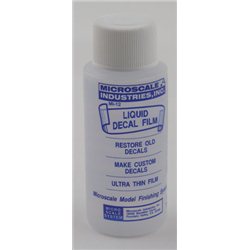
Micro Liquid Decal Film
Price: £ 6.00Micro Liquid Decal Film is mainly used for restoring old decals/transfers....
Decal Paper Laser White
Price: £ 2.00-
Related posts
-
 Do I need to varnish after applying a decal?The simple answer is yes, it is advisable to varnish your decal, for a couple of reasons One being that if the model...
 - How do I apply decals to irregular surfaces?This is not as difficult as you would think. Normally you would dip your transfer in warm water to help remove it...
- How do I use Micro sol and Micro set with waterslide decals (transfers)?When you are at the final stages of making your model, apply a coat of gloss varnish this will give a nice smooth...
- Do I need to varnish before applying a decal?It is a good idea to give your model a coat of gloss varnish before applying decals as this helps with the gluing...
- Can you just varnish where you intend to place the decals?It is best to varnish the whole model. By coating the whole model in varnish, you are guaranteed a uniform finish...