When planning a model railway, there's no rule telling you where you can and can't place your track, after all, it's...

Cart 0 Product Products (empty)
No products
Free shipping! Shipping
£ 0.00 Total
Product successfully added to your shopping cart
Quantity
Total
There are 0 items in your cart. There is 1 item in your cart.
Total products (tax incl.)
Total shipping (tax excl.) Free shipping!
Total (tax incl.)
Search Tips
Tips categories
Latest Tips
-
 Can I fit track on the edge of a baseboard?Read more
 -
 Why do the British use 00 gauge instead of H0?Read more
In Britain we love our 00 gauge model railways. It is the most popular gauge to model in closely followed by N gauge,...
-
 What is the best wood for baseboards?Read more
The most common wood for baseboards is probably chipboard as this is relatively inexpensive. Plywood is another...
-
 How long does it take for enamel paint to fully dry?Read more
Most enamel model paints will be fully dried (cured) between 48 and 72 hours after application.Of course, there...
-
 How can I protect my track from oxidisation ?Read more
Oxidation, also known as rust, can be a common problem for model railway tracks, especially if they are exposed to...

How tall should trees be in N gauge?
Trees come in all shapes and sizes, some you can stand under and not be able to reach the bottom branch, some bottom branches will slap you in the face, so there is no specific one size fits all.
The next time you go out, take a look at all the different types and sizes of trees.
When adding trees to your layout, stand at the best viewing point and think where your trees should go to give the best visual impact. Add bigger trees to the front and smaller trees to the back, this will create perspective and will be a visual treat for any admirers.
If you are still unsure about the size, try offering up an N gauge figure to the base of the trees you are interested in, this will give you a better idea when you are tree shopping and away from your layout.
Most manufacturers of trees say that their trees are suitable for any scale and this is true as a big tree in a scale is a small bush in another one. For this reason, there is a wide choice of realistic trees available in all shapes and sizes.
Click here to receive the tips weekly in your mailbox. You can unsubscribe at any time.
Related products
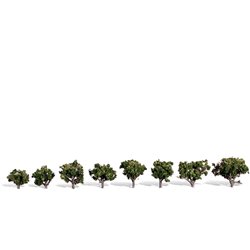
0.75in.-1.25in. Sun Kissed - Pack of 8
Price: £ 18.25Pack of 8x Sun Kissed Trees by Woodland Scenics.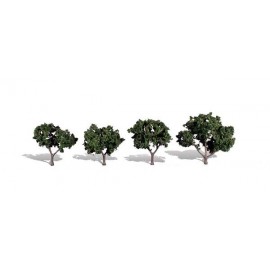
Related posts
-
 Do I need to paint my base boards?I would recommend painting your base board for two reasons: The first being it will seal the base board and prevent...
 - Is static grass better than scatter?I use both, separately and together. Static grass comes in various sizes from 0.5mm to 12mm while scatter is...
- How do I apply static grass?Static grass is best applied using a static grass applicator. There are several on the market and they can apply...
- What is a Diorama?A diorama is three-dimensional scene creating a moment in time, this could be a historical event or a fictional one,...
- What is the best wood for baseboards?The most common wood for baseboards is probably chipboard as this is relatively inexpensive. Plywood is another...