If you're modelling the Southern region, the Underground, or any other railway that uses a conductor rail in OO...

Cart 0 Product Products (empty)
No products
Free shipping! Shipping
£ 0.00 Total
Product successfully added to your shopping cart
Quantity
Total
There are 0 items in your cart. There is 1 item in your cart.
Total products (tax incl.)
Total shipping (tax excl.) Free shipping!
Total (tax incl.)
Search Tips
Tips categories
Latest Tips
-
 How can I model a OO gauge conductor rail for EMUs etc?Read more
 -
 What are the main advantages of using a spray booth?Read more
A spray booth is a very useful tool for any regular airbrush user. An airbrush will use air pressure to atomise paint...
-
 Can I apply washes and other weathering techniques over decals and stencils without damaging them?Read more
Yes, it is possible to apply washes and other weathering techniques over decals and stencils without damaging them,...
-
 What is 1:160 scale?Read more
To answer the question: What is 1:160 scale? I would like to take a look at what the numbers mean when you see them...
-
 What is a slow action point motor?Read more
Slow action point motors are an alternative to the more commonly used solenoid motors. Their name pretty much...

What is a Plux22 DCC decoder?
A Plux22 DCC decoder is a type of digital decoder used in model railways to control locomotives fitted with a Plux22 socket. This 22-pin interface is now commonly found in many modern, high-spec locomotives. The decoder enables you to control various locomotive functions, such as speed, direction, lighting and sound, using a Digital Command Control (DCC) system.
One of the key benefits of the Plux22 format is its ability to handle a large number of functions. With 22 pins, it offers more connections than older standards, allowing you to control multiple lighting options, sound functions, and even more complex features such as smoke generators or motorised pantographs. This makes the Plux22 particularly suitable for advanced models with a wide range of functions, giving you greater control and realism in your layout.
The Plux22 decoder also supports advanced motor control, which provides smoother running and more precise control at low speeds. Many models fitted with these decoders offer features such as back EMF (electromotive force) control, which maintains a consistent speed regardless of gradients or load. For modellers running more complex layouts with inclines or varied terrain, this can be a real advantage, helping to maintain realistic, reliable performance.
Another strength of the Plux22 system is that it makes installation straightforward. If your locomotive has a Plux22 socket, fitting the decoder is as simple as plugging it in – no need for complex rewiring or soldering. This makes upgrading your models to DCC much easier and less time-consuming, particularly for those who may not be comfortable with more technical installation processes.
Plux22 decoders are often used in conjunction with sound features and many decoders in this format come equipped with sound capabilities. The larger number of pins allows the decoder to control speakers and sound functions, creating a more immersive experience. For example, you can control steam or diesel engine noises, whistles and other effects that match the specific locomotive you're running.
Compatibility is another important aspect. The Plux22 format is increasingly becoming a standard among European manufacturers, including well-known brands like Roco, Fleischmann and Piko. Many British models are also adopting the Plux22 socket, making it a versatile choice if you run a mixed fleet of locomotives. However, it's always a good idea to check your model’s specifications before purchasing a decoder to ensure compatibility.
In summary, a Plux22 DCC decoder is ideal for modellers looking for more control over their locomotives. With its ability to manage a wide range of functions and simplify installation, it’s a great choice for anyone operating a DCC layout, particularly if you’re running modern or highly detailed locomotives. Whether you’re controlling lights, sound, or motor functions, the Plux22 gives you the flexibility and performance needed for a truly realistic and enjoyable railway experience.
Posted in: Power and control
Click here to receive the tips weekly in your mailbox. You can unsubscribe at any time.
Related product
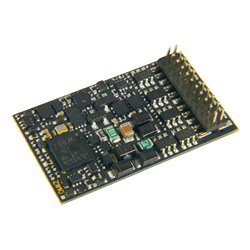
Plux22 DCC Loco-Decoder (with Brake Button...
Price: £ 46.95Plux22 DCC Loco-Decoder (with Brake Button function)
Related posts
-
 Can a "DCC ready" train be used on analogue?Yes, you can use a DCC ready train on your analogue layout. DCC ready just means that the train has been factory...
 - Is it difficult to fit a DCC decoder in to a DCC ready engine?In theory, it should be easy as the whole idea of being DCC Ready is to simplify the process. The first time I did...
- What is 7/0.2 wire?7/02 wire is a wire made of 7 strands of 0.2mm wire. Stranded wire has the advantage of being flexible while solid...
- Is an N Gauge controller compatible with OO Gauge?Yes, an N Gauge controller is compatible with OO gauge trains. You may have to change the power clip to the track...
- Is stranded wire better than solid wire?In my experience, stranded wire is preferable over solid wire. Stranded wire is more flexible than solid core wire,...