We have all been there, with that wagon or coach that derails all of the time, and we suspect that the reason for...

Cart 0 Product Products (empty)
No products
Free shipping! Shipping
£ 0.00 Total
Product successfully added to your shopping cart
Quantity
Total
There are 0 items in your cart. There is 1 item in your cart.
Total products (tax incl.)
Total shipping (tax excl.) Free shipping!
Total (tax incl.)
Search Tips
Tips categories
Latest Tips
-
 How much weight should I add to my rolling stock?Read more
 -
 What is meant by start voltage?Read more
The term 'Start Voltage' is used in model railways to describe how much voltage is needed to get a locomotive moving...
-
 What is a G clamp?Read more
A G clamp is traditionally used in wood working for holding pieces of wood in place whilst being glued etc and come...
-
 What is Wire Glue?Read more
Wire Glue is an electrically conductive glue/paint which has many uses in the hobby world. It is ideal for both AC...
-
 Where would I typically use a Y-shaped turnout on my layout ?Read more
A Y-shaped turnout, also known as a wye turnout, is a type of track configuration that allows a train to diverge onto...

How has the role of the brake van evolved throughout the history of the railways?
Brake vans, also known as guard's vans or caboose cars, have played a vital role in the history of railways. These specialized vehicles were used to ensure safety and control during train operations. In this article, we will explore the evolution of brake vans and their significance in different eras of railway history.
During the early years of the railways, brake vans were an essential part of train formations. They were typically located at the rear of a train and provided a safe space for the guard or conductor to observe the train and communicate with the locomotive crew. The guard's primary responsibility was to apply the brakes when necessary, hence the name "brake van."
In the steam era, brake vans were often built with wooden bodies and had a distinctive look. They featured a raised lookout platform at one or both ends, allowing the guard to have a clear view of the train. These vans were equipped with handbrakes, which the guard operated manually to control the train's speed and ensure safe braking.
As railways advanced and technology improved, the role of brake vans evolved. In the diesel and electric era, the need for guards to manually operate brakes diminished with the introduction of automatic braking systems. This led to the gradual phasing out of traditional brake vans, as their primary function became redundant.
However, brake vans still found their place in certain types of trains, such as freight trains carrying hazardous materials. These vans were modified to include additional safety features like reinforced walls and specialized equipment to handle dangerous goods. They served as a buffer between the locomotive and the hazardous cargo, providing an extra layer of protection.
In recent years, the use of brake vans has further diminished with the implementation of advanced technology and improved safety systems. Most modern trains are equipped with sophisticated braking systems, which are controlled by the locomotive crew. The need for a dedicated brake van has become almost obsolete in many railway operations.
Despite their declining use, brake vans hold a significant place in the history of the railways. They represent an era when manual intervention was crucial for safe train operations. Today, they are often preserved as historical artefacts or used in heritage railways to recreate the atmosphere of a bygone era.
In conclusion, brake vans have played a crucial role in different eras of railway history. From their early days as essential components of train formations to their gradual phasing out in modern railway operations, these specialized vehicles have witnessed significant changes. Understanding the evolution of brake vans provides us with insights into the advancements in railway technology and the importance of safety in train operations.
Posted in: Rolling stock
Click here to receive the tips weekly in your mailbox. You can unsubscribe at any time.
Related products
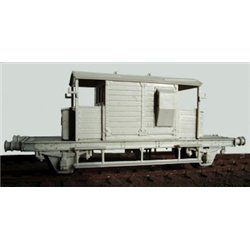
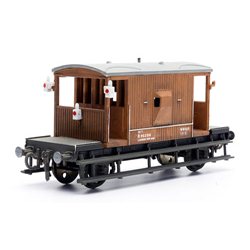
Brake Van (Dapol - Kitmaster)
Price: £ 10.50Plastic kit of a Brake Van by Dapol. This kit will construct a detailed brake...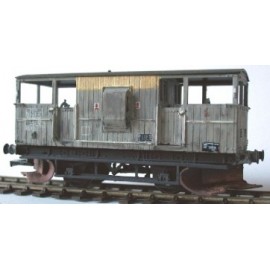
Related posts
-
 How to weight my model so it does not tip?For wargaming figures, a small coin or washer glued to the under side of the base will usually to do the job. This...
 - Is Bachmann compatible with Hornby?Yes, any OO scale loco, wagon or coach will work on any OO scale track, regardless of brand. Couplings are also...
- What are tension lock couplings?Tension lock couplings are the standard couplings for model trains in the UK. These are the ones we all know from...
- How do I test the width between the wheels of my engines?The best way to check the wheels of your locomotives is to use a tool called a back to back gauge. They are...
- How do I clean the wheels of my engine?One easy way is to get yourself a Peco cleaning kit containing a wire brush, wheel scraper, foam cradle and oil. The...