There are many reasons why model trains derail, sometimes it's a track fault, sometimes it's because the train isn't...

Cart 0 Product Products (empty)
No products
Free shipping! Shipping
£ 0.00 Total
Product successfully added to your shopping cart
Quantity
Total
There are 0 items in your cart. There is 1 item in your cart.
Total products (tax incl.)
Total shipping (tax excl.) Free shipping!
Total (tax incl.)
Search Tips
Tips categories
Latest Tips
-
 Why does my train keep derailing?Read more
 -
 Should I use a brush to apply varnish?Read more
When applying varnish to protect a model's paintwork, you should aim for a finish that exhibits the least amount of...
-
 What is balsa glue and how do I use it?Read more
Balsa glue is a specialised adhesive designed specifically for bonding balsa wood. It's often the preferred choice...
-
 What is Hornby Dublo?Read more
Hornby Dublo was an early brand name for models produced by the company that we now all know as Hornby. The brand was...
-
 What are the filler caps for on the running board of a Jubilee Class?Read more
Railway modellers love details, but sometimes a prototype's details can leave us scratching our heads and wondering...

What are the best materials to use to construct the baseboard for my first layout ?
When it comes to constructing the baseboard for a model railway layout, there are a few materials that are commonly used and recommended for their durability and ease of use. The choice of materials will depend on the personal preferences of the modeller, their budget and the size of the layout. Here are some popular options:
- Plywood : Plywood is a versatile and widely used material for baseboard construction. It is sturdy, relatively inexpensive, and readily available in various thicknesses. Opt for a thickness of around 12mm (1/2 inch) for a solid baseboard. Plywood can be easily cut to size and provides a stable foundation for a layout.
- Extruded polystyrene foam (XPS) : XPS foam is a lightweight and easy-to-work-with material that is popular among model railway enthusiasts. It is available in large sheets and can be easily cut, shaped and carved to create different terrain features such as embankments, hills and cliff faces. XPS foam also has good insulation properties, which can help reduce noise and vibrations.
- MDF (medium density fibreboard) : MDF is a dense and smooth material that provides a solid base for a layout. It is less prone to warping compared to plywood and offers a smooth surface for track laying and scenery construction. However, MDF can be heavier than other options, so consider this if future portability is a factor. It also needs to be sealed otherwise any moisture will make it bulge.
- Cork mats or sheets : Cork is a great material to use for the foundations of a track bed. It is light, relatively cheap and ca be easily cut to shape to match the intended track plan. It has noise and vibration dampening qualities which are useful factors to consider if the layout is to be operated in areas where other people will be present.
Regardless of the materials chosen, it is important to reinforce the baseboard to prevent sagging over time. Adding support beams or cross-bracing underneath the baseboard can help distribute the weight evenly and ensure a stable foundation.
Remember, the choice of baseboard material ultimately depends on the specific needs and preferences of the individual modeller. Other factors such as budget, layout size and personal skill level will also need to be considered when making any decision. Happy modelling!
Posted in: Model Railway
Click here to receive the tips weekly in your mailbox. You can unsubscribe at any time.
Related products
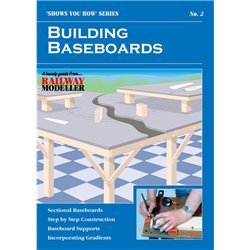
Building Baseboards
Price: £ 1.00Book "Shows You How" - No 2 - Building Baseboards The Peco 'Shows You How'...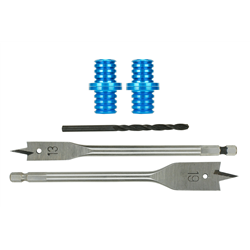
Baseboard Dowels (with Spade Drill Bits) (2 Pack)
Price: £ 17.95Baseboard Dowels (with Spade Drill Bits) (2 Pack)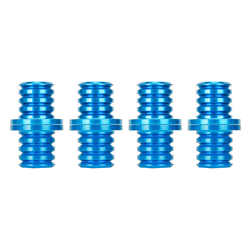
Related posts
-
 What scale is Hornby?Hornby model railways are OO Scale or 1/76th that is 4 millimetres to the foot (12 inches). It runs on a track with...
 - How to weight my model so it does not tip?For wargaming figures, a small coin or washer glued to the under side of the base will usually to do the job. This...
- Is Bachmann compatible with Hornby?Yes, any OO scale loco, wagon or coach will work on any OO scale track, regardless of brand. Couplings are also...
- What are the model railway eras?According to Bachmann, as it states in their catalogue there are 9 eras. As they say in their catalogue this is not...
- Can a "DCC ready" train be used on analogue?Yes, you can use a DCC ready train on your analogue layout. DCC ready just means that the train has been factory...