The best scale to model armour subjects will depend to some degree on the personal preferences of the individual...

Cart 0 Product Products (empty)
No products
Free shipping! Shipping
£ 0.00 Total
Product successfully added to your shopping cart
Quantity
Total
There are 0 items in your cart. There is 1 item in your cart.
Total products (tax incl.)
Total shipping (tax excl.) Free shipping!
Total (tax incl.)
Search Tips
Tips categories
Latest Tips
-
 As a novice modeller, what is the best scale to model armour subjects in ?Read more
 -
 What is the difference between 45xx Class and Class 45?Read more
The question: What is the difference between a 45xx Class and a Class 45? should really be: What isn't the...
-
 Can you mix and match various manufacturers paints?Read more
The most important rule to remember when mixing paints is to never mix enamel and acrylic paint, this is because one...
-
 What are the differences between thin and thick Cyanoacrylate glues?Read more
There are a number of different types of Cyanoacrylate or CA glue and each type has specific characteristics which...
-
 How much should I spend on a locomotive?Read more
It goes back to the old saying: you get what you pay for. The more expensive locomotives out there have slightly...

What is the purpose of check rails and where were they typically used?
Check rails are small additional rails that are installed next to the main running rails on a railway track. They serve a specific purpose in ensuring the smooth operation of trains and preventing derailments.
The primary purpose of check rails is to guide the flanges of a train's wheels and keep them aligned with the main running rails. This is especially important in curves or on sections of track where there is a significant height difference between the rails. By providing an additional guiding surface for the wheels, check rails help to maintain stability and prevent the wheels from riding up and derailing.
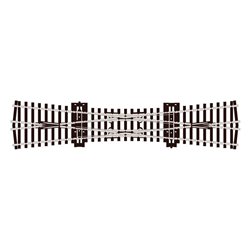
Check rails were typically used in situations where ther was a risk of derailment, such as on sharp curves, inclines, or on sections of track with uneven or unstable ground. They are also used in railways points to help ensure the flange on the wheels of a train do not pass on the wrong side of the frog.
Check rails are also to be found on various aspects of railway modelling. They are frequently located on points and serve the same purpose on model railways as they do in the real world, to ensure the correct alignment of a train's wheels and to lessen the chances of a derailment.
Overall, the purpose of checkrails is to enhance the operational reliability and safety of railways by providing additional guidance for the train wheels. They are typically used in situations where there is a higher risk of derailment, and can be particularly beneficial in smaller scales or on more challenging track layouts.
Posted in: Tracks
Click here to receive the tips weekly in your mailbox. You can unsubscribe at any time.
Related product
Related posts
-
 How to clean model railways track?There is of course the old tried and tested method, the track rubber which does the job, no railway modeller should...
 - Is Peco track and Hornby track compatible?Peco Setrack and Peco Streamline are compatible with Hornby track as they all share the same gauge width of 16.5mm....
- How often should I clean my track?This a hard question to answer. There are no hard and fast rules about how often you should clean the track. Bear in...
- How do I cut flexible track?Once upon a time I would have said a newly bladed junior hacksaw and some warding files, but these days I would have...
- How many pieces of curved track do I need to make a circle?As we all know it takes 360 degrees to create a circle, a standard curve is 22.5 degrees and a double curve is 45...