A track plan is essentially the blueprint or schematic that guides you in constructing your miniature railway system....

Cart 0 Product Products (empty)
No products
Free shipping! Shipping
£ 0.00 Total
Product successfully added to your shopping cart
Quantity
Total
There are 0 items in your cart. There is 1 item in your cart.
Total products (tax incl.)
Total shipping (tax excl.) Free shipping!
Total (tax incl.)
Search Tips
Tips categories
Latest Tips
-
 What is model railway track plan?Read more
 -
 How do I apply static grass?Read more
Static grass is best applied using a static grass applicator. There are several on the market and they can apply...
-
 Can I mix H0 and 00 engines?Read more
You can mix H0 et 00 engines as they run on the same gauge of track and use the same controllers with no problem...
-
 In soldering, what is tinning?Read more
Officially, tinning is the process of coating certain metals with a thin sheet of tin to prevent rust, in soldering,...
-
 What is an eggbeater drill?Read more
An 'eggbeater' is a type of hand drill so-called because its appearance resembles an egg whisk.Officially known...

How do I remove paint from a model?
In the past some people have said to use oven cleaner to remove paint. I have found that this is quite an evasive method and can remove the glue from the model as well, and you end up with paint left on some pieces of the model which just ends up as a tacky mess.
There are various methods for removing small amounts of paint to complete models, acetone being a firm favourite but check on a small area first as some plastics can react with acetone and melt or deform.
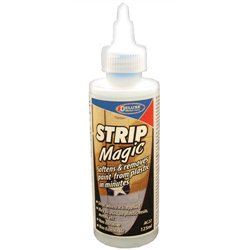
There are products on the market that will remove paint such as Strip Magic from Deluxe Materials. These products have the right strength and have been fully tested to be safe on most types of kits. As such this is probably the best approach.
Posted in: Fix, restore and customize
Click here to receive the tips weekly in your mailbox. You can unsubscribe at any time.
Related product
Related posts
-
 How to remove super glue (cyanoacrylate)?Cyanoacrylate is best known as super glue. The best way to remove it is with acetone or an acetone-based product...
 - What are ejector pins?Ejector pins are used in the injection moulding process of the manufacturing of plastic kits and die cast kits. They...
- How do I bend plastic?BEWARE RISK OF BURNS With most plastic, hot water is usually enough to bend it. If you are straightening weapon...
- What is kit bashing?Kit bashing is when you take two or more model kits to make something unique to you. This may include parts that you...
- Is it a good idea to use second-hand track?Personally, I would never use second hand track as you don't really know what you are getting. Over time track will...