The knowledge that we acquire when building our model railway layouts leaves us with no doubt about the difference...

Cart 0 Product Products (empty)
No products
Free shipping! Shipping
£ 0.00 Total
Product successfully added to your shopping cart
Quantity
Total
There are 0 items in your cart. There is 1 item in your cart.
Total products (tax incl.)
Total shipping (tax excl.) Free shipping!
Total (tax incl.)
Search Tips
Tips categories
Latest Tips
-
 What is the difference between a train set and a layout?Read more
 -
 What does "analogue compatible" means for a DCC decoder?Read more
"Analogue compatible" means the decoder is able to run on a traditional analogue layout that is not DCC. This is...
-
 How has the role of the brake van evolved throughout the history of the railways?Read more
Brake vans, also known as guard's vans or caboose cars, have played a vital role in the history of railways. These...
-
 Why do some N gauge tracks have irregularly spaced sleepers?Read more
During a trip to your local model shop, you may have noticed what looks like N gauge model railway track with...
-
 How do I fill gaps in a model?Read more
There are a couple of different product types you can use to fill gaps on a model, which type you use will depend on...

What coarseness ballast should I use for my OO scale railway?
Ballast comes in varying degrees in coarseness, fine medium and coarse.
For OO scale the most realistic would have to be medium. OO gauge is 1/76 scale so measure a few ballast stones and multiply the size by 76 to check whether it would be correct in real life.
Although there is nothing to say that you cannot use any of the others on your layout.
You could use coarse ballast in your quarry scene to represent ballast to be broken down and fine ballast on the quarry floor to represent fragments.
Use all three types of ballast to create wagon loads.
Click here to receive the tips weekly in your mailbox. You can unsubscribe at any time.
Related products
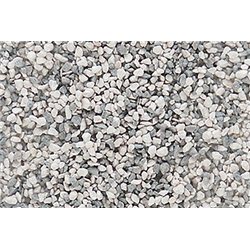
Grey Blend Medium Ballast
Price: £ 16.50Realistically model railroad track, crushed rock and stones. Easy to use and...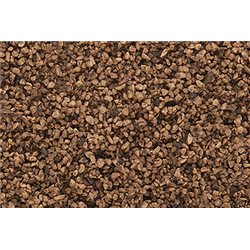
Brown Medium Ballast
Price: £ 16.50Realistically model railroad track, crushed rock and stones. Easy to use and...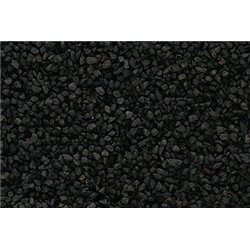
Cinders Medium Ballast
Price: £ 16.50Realistically model railroad track, crushed rock and stones. Easy to use and...
Related posts
-
 Is static grass better than scatter?I use both, separately and together. Static grass comes in various sizes from 0.5mm to 12mm while scatter is...
 - How do I apply static grass?Static grass is best applied using a static grass applicator. There are several on the market and they can apply...
- What colour are tree trunks?Tree trunks are actually grey in colour and not brown as you would think. The next time you are out and about just...
- How to make hills?You can make hills in a variety of ways. The tried and tested way is with chicken wire and papier mache. This is a...
- How do I glue scatter?Select the area where you want the scatter, then apply a layer of PVA glue, sprinkle your grass covering the glue....