Hornby Railroad models are a range of locomotives and rolling stock manufactured by Hornby to be a little less...

Cart 0 Product Products (empty)
No products
Free shipping! Shipping
£ 0.00 Total
Product successfully added to your shopping cart
Quantity
Total
There are 0 items in your cart. There is 1 item in your cart.
Total products (tax incl.)
Total shipping (tax excl.) Free shipping!
Total (tax incl.)
Search Tips
Tips categories
Latest Tips
-
 What is the Hornby RailRoad range?Read more
 -
 Why was the British Railways late crest implemented?Read more
In 1955 an act commonly known as the 'Modernisation Plan' was passed with the intensions of modernising British...
-
 What to do when plastic cement doesn't cement!Read more
Plastic cement is a formula that temporarily softens and melts the surface of most plastics. This makes it very...
-
 How can I add rust and weathering effects to white metal parts?Read more
A number of modellers will work with white metal components as either part of their model or as additional...
-
 How do I add simple paint chips with a foam sponge ?Read more
When assembly and painting of a model are completed, many modellers will wish to add some degree of wear and tear to...

What type of locomotive is a 'Jinty' and what were they used for ?
The term 'Jinty' refers to a specific type of steam locomotive that was commonly used in the United Kingdom. Officially known as the Fowler 3F Class, the Jinty locomotives were a class of small, tank engines that were designed for shunting and local freight duties. They were primarily used on industrial and suburban railway lines.
The Jinty locomotives were built by the London, Midland and Scottish Railway (LMS) between 1924 and 1931. They were given the nickname 'Jinty' due to their resemblance to a cartoon character called 'Ginny Jinty' that appeared in a popular comic strip at the time.
These locomotives had a 0-6-0 wheel arrangement, which means they had six driving wheels and no leading or trailing wheels. They were equipped with a small water tank and coal bunker, allowing them to operate without the need for a separate tender.
The Jinty locomotives were known for their versatility and reliability. They were well-suited for shunting duties, which involved moving wagons and carriages around in railway yards. They were also used for short-distance freight hauling, such as delivering goods to local industries and businesses.
Due to their compact size and good acceleration, Jinty locomotives were often used on suburban passenger services as well. They were capable of pulling a few carriages and were particularly useful on routes with frequent stops and short distances between stations.
Jintys are also a popular locomotive subject for model railways with a number of manufacturers producing items in a range of scales, including O, OO/HO and N gauges.
The Jinty locomotives were a common sight on many railway lines in the UK during the mid-20th century. However, with the decline of steam traction and the advent of diesel and electric locomotives, the Jinty class gradually became obsolete. Over 400 Jinty locomotives were produced and at least 9 have been preserved and can still be seen in collections or in operation on heritage railways today.
Posted in: Rolling stock
Click here to receive the tips weekly in your mailbox. You can unsubscribe at any time.
Related products
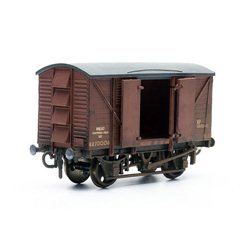
10 Ton Ventilated Meat Van (Dapol - Kitmaster)
Price: £ 10.50Meat Van, HO/OO scaleComes with tension lock couplings (Hornby style couplings).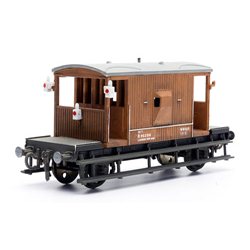
Brake Van (Dapol - Kitmaster)
Price: £ 10.50Plastic kit of a Brake Van by Dapol. This kit will construct a detailed brake...
Related posts
-
 How to weight my model so it does not tip?For wargaming figures, a small coin or washer glued to the under side of the base will usually to do the job. This...
 - Is Bachmann compatible with Hornby?Yes, any OO scale loco, wagon or coach will work on any OO scale track, regardless of brand. Couplings are also...
- What are tension lock couplings?Tension lock couplings are the standard couplings for model trains in the UK. These are the ones we all know from...
- How do I test the width between the wheels of my engines?The best way to check the wheels of your locomotives is to use a tool called a back to back gauge. They are...
- How do I clean the wheels of my engine?One easy way is to get yourself a Peco cleaning kit containing a wire brush, wheel scraper, foam cradle and oil. The...