The first thing you need to know when calculating gradients is that it doesn't matter which unit of measurement you...

Cart 0 Product Products (empty)
No products
Free shipping! Shipping
£ 0.00 Total
Product successfully added to your shopping cart
Quantity
Total
There are 0 items in your cart. There is 1 item in your cart.
Total products (tax incl.)
Total shipping (tax excl.) Free shipping!
Total (tax incl.)
Search Tips
Tips categories
Latest Tips
-
 How do I calculate the space needed for an incline on my model railway layout?Read more
 -
 What are my options for motorising a level crossing?Read more
There are a few options for motorising a level crossing on a model railway layout: Servo motor: One option is to use...
-
 What is a back to back gauge?Read more
A back to back gauge is an instrument for measuring and setting up the distance between wheels on an axle of a model...
-
 How often should I run my locomotives to avoid performance issues?Read more
To avoid performance issues, it is generally recommended that modellers run their locomotives on a regular basis. The...
-
 In simple terms what is tabletop gaming?Read more
Tabletop gaming is a form of gaming where players gather around a table and use physical game pieces, such as...

How can I best paint realistic-looking faces on 1/35 and 1/56 scale figures?
Painting realistic faces on scale figures can be a challenging task but with the right techniques and patience, it is possible to achieve lifelike results.
Here are some recommendations that may help modellers to achieve realistic faces on 1/35 and 1/56 scale figures :
- Prepare the figure : before painting, make sure the figure is clean and free from any dust or debris. This can be achieved by initially washing the figures in warm water with a mild detergent. Prior to painting a soft brush or a can of compressed air can be utilised to remove any final unwanted particles.
- Basecoat : start by applying a basecoat of flesh tone to the face. Choose a colour that matches the desired skin tone. For 1/35 and 1/56 scale figures, acrylic paints work well as they dry quickly and are easy to work with. Apply the basecoat evenly, making sure to cover the entire face.
- Shadows and highlights : shadows and highlights can now be added to the face to create depth and realism. Use a darker shade of the base colour to paint the areas that would naturally be in shadow, such as the eye sockets, under the cheekbones and along the jawline. Then, use a lighter shade to paint the areas that would catch the light, such as the forehead, nose and cheeks. Blend the colours together smoothly to create a seamless transition.
- Eyes and eyebrows : eyes are the focal point of the face, so it's important to paint them carefully. Start by painting the whites of the eyes using a small brush and white paint. Then, use a fine-tipped brush to add the iris and pupil. Finally, paint the eyebrows using a thin brush and a dark brown or black paint.
- Lips and facial details : use a small brush and a light shade of pink or red to paint the lips. Be careful to keep the lines clean and defined. Subtle shading to the lips can also be added by using a slightly darker shade of the base colour along the edges. Don't forget to paint other facial details such as the nostrils, ears, and any facial hair if applicable.
- Finishing touches : once the Modeller is satisfied with the overall look of the face, they can add some final touches to enhance realism. A fine-tipped brush and a dark wash can be used to add depth to the creases and wrinkles on the face. On completion, a matte varnish can be utilised to seal the paint and protect it from wear and tear.
Remember, practice makes perfect, so don't be discouraged if the first attempts don't turn out exactly as hoped for. Many kits and figure sets in 1/35 and 1/56 scales contain alternative head options and can be used to practice on and experiment with different techniques and colours to achieve the desired result.
Posted in: Painting
Click here to receive the tips weekly in your mailbox. You can unsubscribe at any time.
Related products
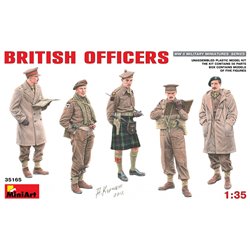
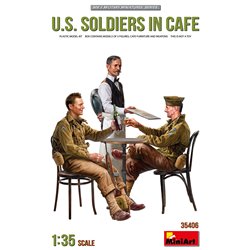
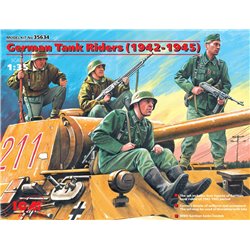
German Tank Riders 1942-45 (4 x Figure) - 1:35...
Price: £ 8.75German Tank Riders 1942-45 (4 x Figure)
Related posts
-
 Do I need to use a primer?For best results it is advisable to use a primer as this will stick to the plastic and give a uniform coat of paint...
 - What is weathering?Weathering is a painting technique used by modellers to create the appearance of dirt and grime and even damage to...
- How do I clean brushes used with enamel paint?Enamel paint is solvent based, so trying to wash in water will not work, you need to use white spirit. It is...
- How do I fill holes in a model?There are many products on the market for filling holes: There are plastic putties straight out of the tube, there...
- What is the best size paintbrush?This would depend on what you are painting as paint brushes come in various shapes and sizes. I would say for...