It is not advisable to use 3-in-1 oil to lubricate your models, especially not the fine parts inside their...

Cart 0 Product Products (empty)
No products
Free shipping! Shipping
£ 0.00 Total
Product successfully added to your shopping cart
Quantity
Total
There are 0 items in your cart. There is 1 item in your cart.
Total products (tax incl.)
Total shipping (tax excl.) Free shipping!
Total (tax incl.)
Search Tips
Tips categories
Latest Tips
-
 Can I use 3-in-1 oil to lubricate my models?Read more
 -
 Why are some passenger carriages configured as clerestory?Read more
Clerestory carriages were a common style of passenger carriage in the late 19th and early 20th centuries,...
-
 What are point levers?Read more
Point levers, integral components in railway infrastructure, facilitate the safe and efficient movement of trains...
-
 What is a gunpowder van?Read more
As the name suggests, gunpowder vans were used to transport gunpowder and other explosive materials by rail. The...
-
 What is a Gibbet Crane?Read more
The term Gibbet is most commonly associated with the kind of gallows-like structure used to hang people, but thanks...

What are solenoid point motors?
Solenoid point motors are used for throwing the points on your layout. They can also be used for other animations such as semaphore signals.
The point motor uses two solenoids to pull a metal rod towards them, when this is connected to the tie bar on the points the points can be changed.
They usually require 3 wires: one common to both solenoids and one for each side for the motor. When power is applied to the common and one side, this completes the circuit and activates one solenoid which in effect becomes a magnet moving the rod.
They are available for under your base board, ideal for areas of your layout where you don't want to see a point motor shed, or ruin the landscape, or surface mounted when you can't quite squeeze one in underneath or a motor shed won't look out of place.
There is a wide variety of point motors available in many shapes and sizes, if you are unsure of the right one for you, maybe take a picture of the area where the motor needs to go if you can, best to take a picture of above and below if possible, and then ask in your local model shop.
Posted in: Power and control
Click here to receive the tips weekly in your mailbox. You can unsubscribe at any time.
Related products
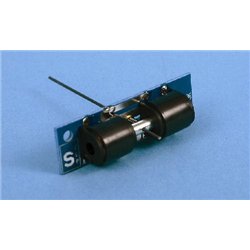
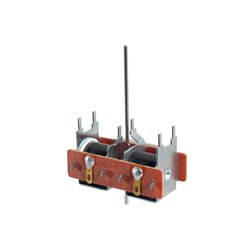
Point Motor (Extended Pin)
Price: £ 10.20Extended Pin Turnout Motor (also referred to as a point motor) A versatile...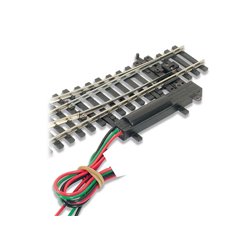
Side Mounted Turnout Motor
Price: £ 12.95Side Mounted Turnout Motor Clips directly into a Peco 00/H0 Setrack Turnout,...
Related posts
-
 Can a "DCC ready" train be used on analogue?Yes, you can use a DCC ready train on your analogue layout. DCC ready just means that the train has been factory...
 - Is it difficult to fit a DCC decoder in to a DCC ready engine?In theory, it should be easy as the whole idea of being DCC Ready is to simplify the process. The first time I did...
- What is 7/0.2 wire?7/02 wire is a wire made of 7 strands of 0.2mm wire. Stranded wire has the advantage of being flexible while solid...
- Is an N Gauge controller compatible with OO Gauge?Yes, an N Gauge controller is compatible with OO gauge trains. You may have to change the power clip to the track...
- Is stranded wire better than solid wire?In my experience, stranded wire is preferable over solid wire. Stranded wire is more flexible than solid core wire,...