Dazzle Camouflage patterns were first introduced during the First World war in order to protect warships and merchant...

Cart 0 Product Products (empty)
No products
Free shipping! Shipping
£ 0.00 Total
Product successfully added to your shopping cart
Quantity
Total
There are 0 items in your cart. There is 1 item in your cart.
Total products (tax incl.)
Total shipping (tax excl.) Free shipping!
Total (tax incl.)
Search Tips
Tips categories
Latest Tips
-
 Why did warships wear dazzle camouflage patterns?Read more
 -
 Can I clean my model railway rails with sandpaper?Read more
Cleaning model railway tracks can be laborious at the best of times, so it's no surprise that modellers keep on...
-
 What is Thomas the Tank Engine?Read more
Thomas the Tank Engine is a beloved British children's character who originated in a series of books titled The...
-
 What is dry brushing?Read more
Dry brushing is a painting technique where only a small amount of paint is administered to the model in order to...
-
 What are my options for controlling a turntable?Read more
The available options for controlling a turntable are varied. The most basic method of controlling a turntable is by...

What is meant by 'wet sanding' and where is it typically used?
Wet sanding is a technique used in scale modelling and other forms of modelling where a sanding medium is used in conjunction with water or a lubricant to sand a surface. The water or lubricant helps to reduce friction and prevent the sandpaper from clogging up with debris, resulting in a smoother finish.
Wet sanding is typically used on surfaces that require a high level of smoothness and finish, such as car bodies, aircraft models, and other detailed pieces. It can also be used to remove imperfections and blemishes from surfaces before painting or other finishing techniques are applied. Wet sanding is a delicate process and requires patience and attention to detail to ensure the best results.
For example, when building a model car, wet sanding can be used to smooth out any imperfections in the bodywork before applying a coat of paint. This can help to achieve a professional-looking finish and make the car look more realistic. Wet sanding can also be used on other parts of the model, such as the wheels or interior, to achieve a smooth and polished finish.
It is important to note that wet sanding can be messy and potentially damaging to surfaces if not done correctly. Modellers should always use the appropriate grit of sandpaper for the job and be sure to keep the surface wet and lubricated throughout the process.
One significant benefit of wet sanding is that in many ways it is a safer alternative for the modeller. Dry sanding has the potential to release large amounts of very fine dust into the air which can be inhaled by the modeller leading to various health issues. With wet sanding the presence of liquid in contact with the surface means that the technique tends to trap this dust making this a much safer alternative. Many modellers choose wet sanding specifically for this reason.
Posted in: Painting
Click here to receive the tips weekly in your mailbox. You can unsubscribe at any time.
Related products
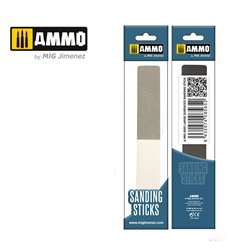
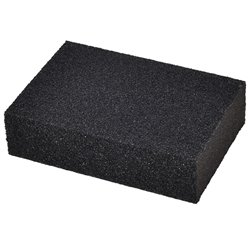
Fine/medium dual grit (P120/P80) sanding sponge
Price: £ 1.99Fine/medium dual grit (P120/P80) sanding sponge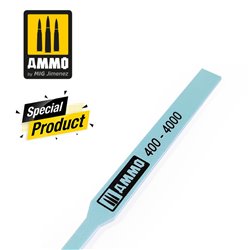
Polish sanding stick
Price: £ 3.50Polish sanding stick This sanding stick provides 2 different grits: 400/4000,...
Related posts
-
 Do I need to use a primer?For best results it is advisable to use a primer as this will stick to the plastic and give a uniform coat of paint...
 - What is weathering?Weathering is a painting technique used by modellers to create the appearance of dirt and grime and even damage to...
- How do I clean brushes used with enamel paint?Enamel paint is solvent based, so trying to wash in water will not work, you need to use white spirit. It is...
- How do I fill holes in a model?There are many products on the market for filling holes: There are plastic putties straight out of the tube, there...
- What is the best size paintbrush?This would depend on what you are painting as paint brushes come in various shapes and sizes. I would say for...