The first thing you need to know when calculating gradients is that it doesn't matter which unit of measurement you...

Cart 0 Product Products (empty)
No products
Free shipping! Shipping
£ 0.00 Total
Product successfully added to your shopping cart
Quantity
Total
There are 0 items in your cart. There is 1 item in your cart.
Total products (tax incl.)
Total shipping (tax excl.) Free shipping!
Total (tax incl.)
Search Tips
Tips categories
Latest Tips
-
 How do I calculate the space needed for an incline on my model railway layout?Read more
 -
 What are my options for motorising a level crossing?Read more
There are a few options for motorising a level crossing on a model railway layout: Servo motor: One option is to use...
-
 What is a back to back gauge?Read more
A back to back gauge is an instrument for measuring and setting up the distance between wheels on an axle of a model...
-
 How often should I run my locomotives to avoid performance issues?Read more
To avoid performance issues, it is generally recommended that modellers run their locomotives on a regular basis. The...
-
 In simple terms what is tabletop gaming?Read more
Tabletop gaming is a form of gaming where players gather around a table and use physical game pieces, such as...

Which steam engines were used for shunting?
Various types of steam locomotives were used for shunting operations. Here are some of the commonly seen steam engines used for shunting:
Saddle Tank Engines: Saddle tank engines, also known as saddle tanks, were frequently employed for shunting tasks. These locomotives had a water tank mounted over the top and sides of the boiler, often resembling a saddle shape. The compact size and good visibility from the cab made them well-suited for manoeuvring in yards and tight spaces.
Tank Engines: Tank engines, including side tank engines and pannier tank engines, were commonly utilized for shunting duties. These locomotives had water tanks on either side of the boiler or on top of the boiler, respectively. Their smaller size and agile nature allowed for easy navigation through yards and sidings.
Dock Tanks: Dock tanks were specialized steam locomotives designed for shunting in dockyards and harbours. They featured compact dimensions and often had side tanks and bunker arrangements that allowed them to work efficiently in confined spaces. Dock tanks were primarily employed for moving wagons and carriages between ships and warehouses.
Saddle Tank Pannier Engines: A specific variant of pannier tank engines, known as saddle tank pannier engines, combined the features of both saddle tank engines and pannier tank engines. These locomotives had a water tank mounted on top of the boiler and extended over the footplate, resembling a saddle. They were particularly common in industrial areas and small railways.
Industrial Tank Engines: Various types of industrial tank engines were used for shunting within industrial complexes, factories and private sidings. These locomotives were customized and built to meet the specific requirements of the industrial operations they served. They varied in size, design and features depending on the industry and its specific needs.
It is important to note that the types of steam engines used for shunting varied across different regions, time periods and railway companies. The specific locomotive types employed for shunting operations can differ based on local practices, available infrastructure and operational requirements.
Incorporating one or more of these steam locomotive types on a layout will help recreate the authentic atmosphere and functionality of a shunting yard, industrial area or dockyard.
Posted in: Rolling stock
Click here to receive the tips weekly in your mailbox. You can unsubscribe at any time.
Related product
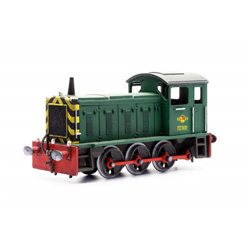
BR Class 04 Drewry Shunter (Dapol - Kitmaster)
Price: £ 15.20204 H.P. 0-6-0 Drewry Shunter Builds a static model (non-motorised) not...
Related posts
-
 How to weight my model so it does not tip?For wargaming figures, a small coin or washer glued to the under side of the base will usually to do the job. This...
 - Is Bachmann compatible with Hornby?Yes, any OO scale loco, wagon or coach will work on any OO scale track, regardless of brand. Couplings are also...
- What are tension lock couplings?Tension lock couplings are the standard couplings for model trains in the UK. These are the ones we all know from...
- How do I test the width between the wheels of my engines?The best way to check the wheels of your locomotives is to use a tool called a back to back gauge. They are...
- How do I clean the wheels of my engine?One easy way is to get yourself a Peco cleaning kit containing a wire brush, wheel scraper, foam cradle and oil. The...