Smoke generators are a great idea for introducing an extra level of realism to your locomotives. The concept is...

Cart 0 Product Products (empty)
No products
Free shipping! Shipping
£ 0.00 Total
Product successfully added to your shopping cart
Quantity
Total
There are 0 items in your cart. There is 1 item in your cart.
Total products (tax incl.)
Total shipping (tax excl.) Free shipping!
Total (tax incl.)
Search Tips
Tips categories
Latest Tips
-
 Why don't more modellers fit smoke generators to their engines?Read more
 -
 How do you calculate scale speed?Read more
Most modellers will not need to calculate scale speed as our passion for railways would undoubtedly have led us at...
-
 What does RTR mean in model railways?Read more
In model railways, the term RTR is mostly used to describe rolling stock or locomotives that are classified as...
-
 What is feedback on a DCC controller?Read more
Most modellers will be aware of how a controller makes a locomotive move along the tracks, with an analogue...
-
 What is a stay-alive?Read more
A stay-alive (or keep-alive) is a capacitor that can be used with a DCC decoder. It stores power to allow for a more...

What is the difference between a Flow Improver and a Flow Retarder and when would I typically use them?
Flow improver and flow retarder are both additives that can be added to acrylic paint when airbrushing to help improve the paint finish. However, they both work in different ways, so it is good to understand the difference between the two.
Flow improver: Flow improver is used to improve the flow and levelling properties of acrylic paint when used with an airbrush. It achieves this by reducing the surface tension of the paint without reducing or weakening the flow of pigment. This makes it especially useful in allowing it to flow into panel lines and follow surface features, helping to accentuate these features more fully when the paint is dry. It is typically used to achieve a flawless finish, especially when painting large surfaces.
Flow retarder: Flow retarder is an additive that is used to slow down the drying time of paint in an airbrush. Acrylic paint tends to dry very quickly, sometimes on the needle of the airbrush itself. This can cause flow problems, uneven paint finishes and in some cases splattering of paint. Using a flow retarder will ensure that the paint will not dry prematurely before it reaches the model, thus improving the effectiveness of the paint finish. Modellers can also take advantage of the slower drying time to blend in other colours and pigments if required or use a Retarder on any other occasion where a longer drying time would be beneficial.
Posted in: Painting
Click here to receive the tips weekly in your mailbox. You can unsubscribe at any time.
Related products
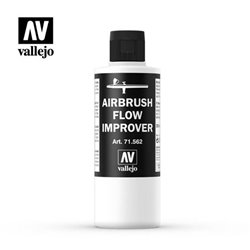
AV Vallejo Model Air - Airbrush Flow Improver...
Price: £ 11.75AV Vallejo Model Air - Airbrush Flow Improver 200ml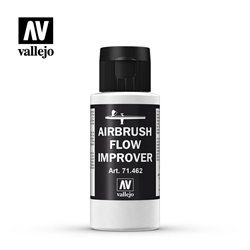
AV Vallejo Model Air - Airbrush Flow Improver 60ml
Price: £ 6.30AV Vallejo Model Air - Airbrush Flow Improver 60ml Airbrush Flow Improver is...
Related posts
-
 Do I need to use a primer?For best results it is advisable to use a primer as this will stick to the plastic and give a uniform coat of paint...
 - What is weathering?Weathering is a painting technique used by modellers to create the appearance of dirt and grime and even damage to...
- How do I clean brushes used with enamel paint?Enamel paint is solvent based, so trying to wash in water will not work, you need to use white spirit. It is...
- How do I fill holes in a model?There are many products on the market for filling holes: There are plastic putties straight out of the tube, there...
- What is the best size paintbrush?This would depend on what you are painting as paint brushes come in various shapes and sizes. I would say for...