Buckeye couplings, also known as Buckeye knuckle couplers, are a type of railway coupling used primarily in North...

Cart 0 Product Products (empty)
No products
Free shipping! Shipping
£ 0.00 Total
Product successfully added to your shopping cart
Quantity
Total
There are 0 items in your cart. There is 1 item in your cart.
Total products (tax incl.)
Total shipping (tax excl.) Free shipping!
Total (tax incl.)
Search Tips
Tips categories
Latest Tips
-
 What are buckeye couplings?Read more
 -
.jpeg "What is back EMF on a DCC decoder?") What is back EMF on a DCC decoder?Read more
What is back EMF on a DCC decoder?Read moreEMF stands for Electromotive Force and requires a fair knowledge of electrics to fully grasp what it is and the...
-
 In the case of a curved station platform, how far should the track be from the platform to avoid damage to the train?Read more
A curved station platform can be a challenging feature to design and construct. One important consideration is the...
-
 With reference to motors used in models, what is meant by the term worm gear?Read more
A worm gear is a type of gear used in model motors that consists of a screw-like shaft (known as a worm) and a wheel...
-
 Is it unrealistic to mix diesel and steam locomotives on the same layout?Read more
It is not necessarily unrealistic to mix diesel and steam locomotives on the same layout. In fact, it was not...

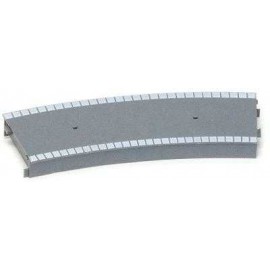
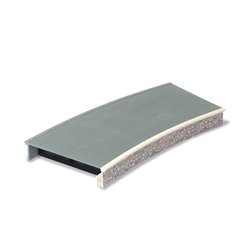
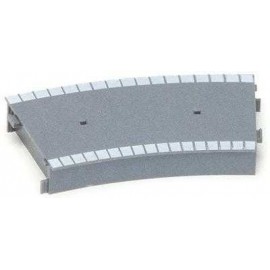
In the case of a curved station platform, how far should the track be from the platform to avoid damage to the train?
A curved station platform can be a challenging feature to design and construct. One important consideration is the distance between the track and the platform, which can affect the safety of the layout and the durability of the rolling stock.
As a rule of thumb, the track should be positioned as far away from the platform as possible without compromising the appearance and functionality of the layout. This is particularly important in the case of a curved platform, as the distance between the track and the platform can vary significantly depending on the angle of the curve. Additionally, it is also important to ensure that both the track and platform segment are of a similar or identical radius, otherwise pinching or distance issues are likely to result.
In the case of OO/HO Gauge, a distance of around 5-7mm between the track and the platform is recommended for curved platforms, although this can vary depending on the scale of the layout and the size of the rolling stock being used. If the track is positioned too close to the platform, there is a risk of damage to the rolling stock, as it may come into contact with the platform or the platform edge.
The best solution to this problem may be to take a bespoke approach. Each layout is different and so testing the distance before the final placement of either the track or station platform is a good idea. This will allow a modeller to determine which distances work best in relation to the safe movement of the train whilst also addressing the aesthetics of the train when it appears stopped at the station.
Modellers should aim to strike a balance between safety and aesthetics when designing and constructing a curved station platform, taking into account the specific needs and requirements of their layout.
Posted in: Model Railway
Click here to receive the tips weekly in your mailbox. You can unsubscribe at any time.
Related products
Related posts
-
 What scale is Hornby?Hornby model railways are OO Scale or 1/76th that is 4 millimetres to the foot (12 inches). It runs on a track with...
 - How to weight my model so it does not tip?For wargaming figures, a small coin or washer glued to the under side of the base will usually to do the job. This...
- Is Bachmann compatible with Hornby?Yes, any OO scale loco, wagon or coach will work on any OO scale track, regardless of brand. Couplings are also...
- What are the model railway eras?According to Bachmann, as it states in their catalogue there are 9 eras. As they say in their catalogue this is not...
- Can a "DCC ready" train be used on analogue?Yes, you can use a DCC ready train on your analogue layout. DCC ready just means that the train has been factory...