Generally speaking, an up line travels towards a major town or city and a down line away from it, on main lines in...

Cart 0 Product Products (empty)
No products
Free shipping! Shipping
£ 0.00 Total
Product successfully added to your shopping cart
Quantity
Total
There are 0 items in your cart. There is 1 item in your cart.
Total products (tax incl.)
Total shipping (tax excl.) Free shipping!
Total (tax incl.)
Search Tips
Tips categories
Latest Tips
-
 What is the difference between an up and down line?Read more
 -
 Historical accuracy in railway modelling: tips and tricksRead more
Railway modelling is a rewarding hobby that combines creativity, craftsmanship, and a passion for trains. For many,...
-
 What is masking fluid used for?Read more
Masking fluid works the same way as masking tape, only it comes in liquid form and is brushed on.Once painted on...
-
 Why is a caliper useful for scale modelling?Read more
A caliper is often an essential tool, yet one that can easily be overlooked or underutilised. While you may relegate...
-
 What era should I model?Read more
If you are just starting out on your model railway adventure and are wondering which era you should model, the answer...

Where could I best use Electrically Conductive paint on my layout ?
Electrically conductive paint can be used in a variety of ways on a model railway layout. One common application is to create electrical connections between different sections of track or between track and other electrical components. As such, it can be a practical alternative to electrical wiring.
For example, a modeller could use conductive paint to create a "jump wire" between two sections of track that might not be properly connected or to create a connection between a section of track and a turnout or other accessory.
Another application for conductive paint is to create custom electronic circuits on a layout. For example, it could be possible to use conductive paint to create a circuit for controlling signals, lights or other accessories. It can also be used to provide other scene elements with electrical connectivity, such as traffic lights or street lights, or even to cameo figures such as a station master with a light signal or the lights on a bicycle. With planning and care, the EC paint can then be subsequently hidden by scenery or other layout features.
When using conductive paint, it is important to follow the manufacturer's instructions carefully and to take appropriate safety precautions. Make sure to wear gloves and work in a well-ventilated area, as the paint can be toxic if ingested or inhaled. Also, be sure to let the paint dry completely before applying power to any circuits or connections.
Posted in: Model Railway
Click here to receive the tips weekly in your mailbox. You can unsubscribe at any time.
Related product
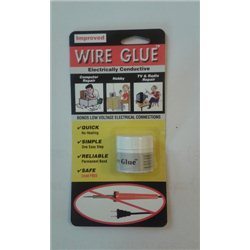
Wire Glue - Conductive paint
Price: £ 7.50Wire Glue - Conductive paint If ordering from the European Union and outside...
Related posts
-
 What scale is Hornby?Hornby model railways are OO Scale or 1/76th that is 4 millimetres to the foot (12 inches). It runs on a track with...
 - How to weight my model so it does not tip?For wargaming figures, a small coin or washer glued to the under side of the base will usually to do the job. This...
- Is Bachmann compatible with Hornby?Yes, any OO scale loco, wagon or coach will work on any OO scale track, regardless of brand. Couplings are also...
- What are the model railway eras?According to Bachmann, as it states in their catalogue there are 9 eras. As they say in their catalogue this is not...
- Can a "DCC ready" train be used on analogue?Yes, you can use a DCC ready train on your analogue layout. DCC ready just means that the train has been factory...