Tracksetta is a term that refers to a tool used for the shaping of flexible track sections, it is sometimes also...

Cart 0 Product Products (empty)
No products
Free shipping! Shipping
£ 0.00 Total
Product successfully added to your shopping cart
Quantity
Total
There are 0 items in your cart. There is 1 item in your cart.
Total products (tax incl.)
Total shipping (tax excl.) Free shipping!
Total (tax incl.)
Search Tips
Tips categories
Latest Tips
-
 Is there a Tracksetta for N gauge?Read more
 -
 What is an automated shuttle system?Read more
An automated shuttle system is what you would use to make a model train go up and down a line without the need for...
-
 How can I transition between different track codes on my layout?Read more
When building a model railway layout, it is not uncommon to use different track codes for various reasons. This can...
-
 What are inspection pits and where would I install one on my layout?Read more
An inspection pit is a feature commonly found in model railway layouts that mimics real-life railway workshops. It is...
-
 What is a cyanoacrylate (super glue) accelerator?Read more
Superglue has strong bonding properties but still takes time to cure. Depending on the type of superglue you use, the...

Can I create working overhead electrification for my layout?
It is possible to create overhead electrification for a model railway layout. This typically involves installing overhead wires and pantographs on the trains to transfer power from the wires to the trains. Overhead electrification can add a realistic touch to a layout, as it is a common method of powering trains in the real world.
To create overhead electrification for a layout, a modeller will need to purchase and install overhead wire systems, pantographs, and controllers. These items are available from model railway suppliers and can be installed on existing trains or on new trains that are specifically designed for overhead electrification.
It is worth noting that creating overhead electrification can be a complex and time-consuming task, requiring some electrical engineering knowledge and additional tools and equipment. Additionally, it is important to ensure that the installation is safe and that the wiring and pantographs are properly maintained.
There are a number of publications available to assist modellers in creating overhead electrification. For example, an excellent place to start will be the 'Modelling Overhead Catenary' published by Peco as part of their 'Shows you how' series. Additional advice can be sought from various sources including internet tutorial videos, channels and forums or from Local Model Railway Groups.
Posted in: Power and control
Click here to receive the tips weekly in your mailbox. You can unsubscribe at any time.
Related products
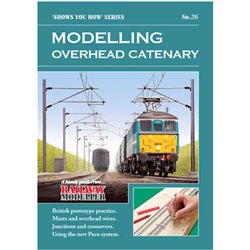
Modelling Overhead Catenary
Price: £ 1.00Modelling Overhead Catenary A comprehensive 16-page "Shows You How" booklet...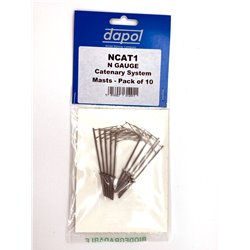
Single Track Catenary Mast (10)
Price: £ 10.90Dapol innovative Easi-Fit Catenary masts are an ideal additon to any N Gauge...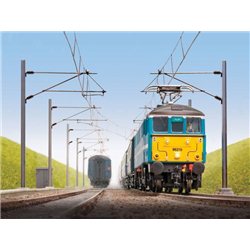
OO/HO Catenary System Startup Pack
Price: £ 143.00Overhead electric catenary system, including masts and contact wires.
Related posts
-
 Can a "DCC ready" train be used on analogue?Yes, you can use a DCC ready train on your analogue layout. DCC ready just means that the train has been factory...
 - Is it difficult to fit a DCC decoder in to a DCC ready engine?In theory, it should be easy as the whole idea of being DCC Ready is to simplify the process. The first time I did...
- What is 7/0.2 wire?7/02 wire is a wire made of 7 strands of 0.2mm wire. Stranded wire has the advantage of being flexible while solid...
- Is an N Gauge controller compatible with OO Gauge?Yes, an N Gauge controller is compatible with OO gauge trains. You may have to change the power clip to the track...
- Is stranded wire better than solid wire?In my experience, stranded wire is preferable over solid wire. Stranded wire is more flexible than solid core wire,...